In stock
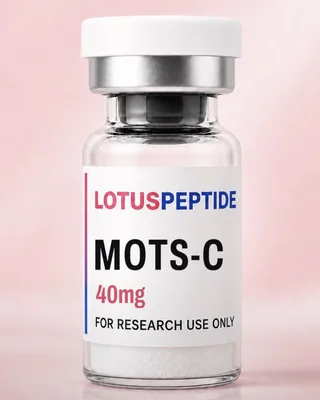
MOTS-C
MOTS-c is a 16-amino-acid peptide (MRWQEMGYIFYPRKLR) encoded by a short open reading frame inside the mitochondrial 12S rRNA gene, which places it among the mitochondrial-derived peptides. Synthetic MOTS-c has no FDA approval for any use and is offered here only as a material for laboratory research.
- Single Vial$45
- 5-Pack (5 vials)$40 per vial$200
- 10-Pack (10 vials)$38.50 per vial Lowest per vial$385
Ships from the United States within 1 business day. Laboratory research use only.
At a glance
- Strengths
- 10 mg and 40 mg
- Also known as
- Mitochondrial open reading frame of the 12S rRNA type-c; MOTS-c (human)
- CAS number
- 1627580-64-6
- Molecular formula
- C101H152N28O22S2
- Molecular weight
- 2174.6 g/mol
- Sequence
- Met-Arg-Trp-Gln-Glu-Met-Gly-Tyr-Ile-Phe-Tyr-Pro-Arg-Lys-Leu-Arg (MRWQEMGYIFYPRKLR)
- PubChem CID
- 146675088
What MOTS-c is
MOTS-c stands for mitochondrial open reading frame of the 12S rRNA type-c 1. It belongs to the mitochondrial-derived peptides, small peptides encoded by short open reading frames in mitochondrial DNA. A 2020 review counted eight of them: MOTS-c, encoded in the 12S rRNA gene (MT-RNR1), and humanin with six small humanin-like peptides, encoded in the 16S rRNA gene 2. In 2018 a University of Southern California laboratory reported that MOTS-c moves into the nucleus during metabolic stress such as glucose restriction, in an AMPK-dependent way. There it was reported to regulate genes with antioxidant response elements and to interact with the transcription factor NRF2 3. A 2019 review from the same group describes MOTS-c as a mitochondrial-encoded factor that regulates nuclear gene expression 4.
Sequence and chemical identity
The human sequence is Met-Arg-Trp-Gln-Glu-Met-Gly-Tyr-Ile-Phe-Tyr-Pro-Arg-Lys-Leu-Arg. PubChem (CID 146675088) gives C101H152N28O22S2 and 2174.6 g/mol. The two sulfur atoms belong to the methionines at positions 1 and 6, and a tryptophan sits at position 3. Three arginines and one lysine give the peptide a strong positive charge. PubChem's synonyms include a trifluoroacetate salt, one of the forms in which synthetic MOTS-c has been catalogued. A 2019 anti-doping assay tracked animal MOTS-c analogues alongside human MOTS-c 1, so the species of origin matters for identity testing.
Regulatory status
There is no FDA-approved MOTS-c product, and a Drugs@FDA search finds no match. After MOTS-c was nominated for pharmacy compounding, FDA assigned it to category 2, the group with potential significant safety risks, and the nominations were later withdrawn. FDA's summary mentions possible immunogenicity and difficulties with peptide-related impurities and characterization of the substance. It adds that FDA has not identified any human exposure data for drug products containing MOTS-c (FDA page last updated April 22, 2026). MOTS-c also appeared on the agenda for the July 23, 2026 meeting of FDA's Pharmacy Compounding Advisory Committee. As of October 3, 2026, FDA had published neither minutes nor a decision from that meeting. The MOTS-c on this page is a laboratory reagent, not a medicine.
Published research
The literature has three main parts: cell and rodent studies with synthetic peptide, measurements of the body's own MOTS-c in people, and analytical method work. Rodent papers on MOTS-c are mostly written up as effects in particular models; those are left out here. A 2020 review of mitochondrial-derived peptides reported that, in humans, muscle expression of these peptides rises in response to stresses that perturb mitochondria, such as exercise 2. On the analytical side, the 2019 anti-doping laboratory developed a liquid chromatography and mass spectrometry (LC/MS) test for MOTS-c in human plasma. The method was validated to World Anti-Doping Agency laboratory standards. It also covers four metabolites formed in vitro and two oxidation products of the peptide 1.
What is not known
No controlled trial of synthetic MOTS-c in people appears in PubMed as of October 2026, and FDA has found no human exposure data. Measurements of the body's own MOTS-c are also uncertain. When the 2019 LC/MS method was compared with a commercial ELISA, the two gave considerably different MOTS-c levels 1. Results from immunoassays and from mass spectrometry therefore cannot be assumed to agree. Three of the five papers cited here, the 2020 and 2019 reviews and the 2018 study, come from authors at one laboratory, and in each the senior author disclosed a consulting role and shareholding in CohBar, Inc. 2 3 4.
Laboratory storage and handling
Store MOTS-c as stated on its certificate of analysis and product label. The solid-state literature lists oxidation, deamidation and aggregation among the slow reactions of dry peptides, with temperature and moisture as major influences 5. Oxidation is directly relevant here. The 2019 LC/MS assay included two oxidation products of MOTS-c among the species it tracks 1, and the sequence carries two methionines and a tryptophan. Keeping the container closed until use limits exposure to air and humidity.
Quality testing
Useful checks on a MOTS-c certificate of analysis:
- Identity: mass spectrometry matching 2174.6 g/mol, with any +16 Da peaks noted, since each corresponds to one added oxygen atom.
- Purity: reverse-phase HPLC, with oxidation products reported as related impurities 1.
- Species: confirmation that the material is the human sequence, not an animal analogue 1.
- Salt and content: the counter-ion and the net peptide content.
The purity of a given lot is stated on that lot's certificate.
Questions
Where is MOTS-c encoded?
In mitochondrial DNA, within the gene for the 12S ribosomal RNA (MT-RNR1). That makes it one of the mitochondrial-derived peptides; humanin and the small humanin-like peptides are encoded in the neighboring 16S rRNA gene 2.
Can MOTS-c levels from different studies be compared?
Only with care. A validated LC/MS method and a commercial ELISA gave considerably different MOTS-c levels in the same 2019 comparison 1, so the measurement method matters when reading reported values.
Has synthetic MOTS-c been tested in human trials?
No controlled human trial of synthetic MOTS-c was found in PubMed as of October 2026, and FDA states that it has not identified human exposure data. Published human work measures the body's own MOTS-c.
References
- Knoop A, Thomas A, Thevis M. Development of a mass spectrometry based detection method for the mitochondrion-derived peptide MOTS-c in plasma samples for doping control purposes. Rapid Commun Mass Spectrom. 2019. pubmed.ncbi.nlm.nih.gov
- Merry TL, Chan A, Woodhead JST, et al. Mitochondrial-derived peptides in energy metabolism. Am J Physiol Endocrinol Metab. 2020. pubmed.ncbi.nlm.nih.gov
- Kim KH, Son JM, Benayoun BA, et al. The Mitochondrial-Encoded Peptide MOTS-c Translocates to the Nucleus to Regulate Nuclear Gene Expression in Response to Metabolic Stress. Cell Metab. 2018. pubmed.ncbi.nlm.nih.gov
- Benayoun BA, Lee C. MOTS-c: A Mitochondrial-Encoded Regulator of the Nucleus. Bioessays. 2019. pubmed.ncbi.nlm.nih.gov
- Lai MC, Topp EM. Solid-state chemical stability of proteins and peptides. J Pharm Sci. 1999. pubmed.ncbi.nlm.nih.gov
This page summarises published laboratory research and cites its sources. It is not medical advice and makes no claim that the compound treats, cures or prevents any condition. LotusPeptide sells it for laboratory research use only.
Shipping and returns
- Shipping
- Orders are processed and shipped within 1 business day.
- Returns
- Returns are not accepted.
- Damaged or lost items
- Replacements and refunds are offered on damaged or lost items.