In stock
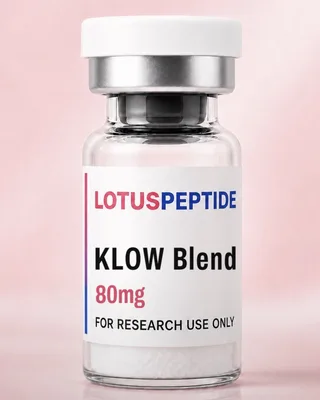
KLOW Blend 80mg
KLOW combines four substances in one vial: 50 mg of the copper complex GHK-Cu, 10 mg of the tripeptide KPV, and 10 mg each of BPC-157 and TB-500, which makes it GLOW plus KPV. None of the four is approved by FDA as a drug, nothing approved contains the mixture, and the vial is a laboratory research material only.
- Single Vial$65
- 5-Pack (5 vials)$45 per vial$225
- 10-Pack (10 vials)$41 per vial Lowest per vial$410
Ships from the United States within 1 business day. Laboratory research use only.
At a glance
- Strength
- 80 mg
What is in a KLOW vial
Each vial holds 80 mg of labelled material in four components:
- GHK-Cu, 50 mg (62.5%), about 124 micromoles as the 1:1 copper complex (402.92 g/mol).
- KPV, 10 mg (12.5%), the tripeptide Lys-Pro-Val (342.43 g/mol), about 29 micromoles. PubChem (CID 125672) titles it MSH (11-13): it corresponds to residues 11 to 13 of alpha-melanocyte-stimulating hormone.
- BPC-157, 10 mg (12.5%), about 7.0 micromoles.
- TB-500, 10 mg (12.5%), 11.2 micromoles as the acetylated fragment Ac-LKKTETQ 1; full-length thymosin beta-4 would give only 2.0. Products under the name have been described as containing either 2.
KPV changes the molar picture more than the mass picture. At 12.5% of the mass it is the second most numerous molecule in the vial, about four for each BPC-157. GHK-Cu remains roughly three of every four molecules. Counterions are not included in these figures. The three components shared with GLOW, and their copper chemistry, are covered in the GLOW article, and each component has its own article.
Overlapping ions in a four-component vial
GHK and KPV are both tripeptides, and their ions sit close together in a mass spectrum. Their formulas, C14H24N6O4 and C16H30N4O4, give singly protonated ions near m/z 341.19 and 343.23. Those main ions are two mass units apart, so even a unit-resolution instrument separates them. The overlap is smaller. GHK also produces a minor isotope peak two units above its main ion, a few percent of its height, from molecules carrying two carbon-13 atoms or an oxygen-18 or nitrogen-15 atom, near m/z 343.19 to 343.20. That peak lies within about 0.04 units of the KPV ion. At unit resolution it can therefore add slightly to a KPV signal, more so because GHK is about four times as abundant as KPV in this vial. Retention time, a high-resolution spectrum or a fragment spectrum removes the ambiguity. When the copper stays bound, GHK-Cu appears near m/z 402.1 instead. A paperwork coincidence also matters. FDA's 2026 briefing gives KPV acetate a molecular weight of 402.5 g/mol, close to the 402.92 g/mol of the 1:1 GHK-Cu complex. A certificate line giving only a molecular weight near 402 should therefore be read alongside the identity data.
What KPV adds to testing
The KLOW certificate needs everything described for GLOW plus a fourth identity and a fourth content value. The copper measurement and the effect of the large GHK-Cu peak are explained in the GLOW article. What KPV adds is specific. Its identity should be confirmed by its own ion near m/z 343.2, using one of the checks above so that the GHK isotope peak is not counted as KPV. Its content should be measured against a KPV reference standard, and the certificate should state whether it is the free base or the acetate. Method development for synthetic peptides routinely weighs several separation modes, not only reversed-phase HPLC 3. Quantifying peptide impurities by LC-MS has known pitfalls 4, so a certificate should state which method was used. Lot results are reported on the certificate, not here.
Published research on the combination
No study of KLOW's four components together was found. A PubMed search on October 3, 2026, for KPV with GHK terms returned one record, a 2025 review of tripeptides. A search for KPV with BPC-157, thymosin or TB-500 terms returned one record, a 2026 review of FDA's compounding advisory committee recommendations. Neither is a primary study of a combination. The searches for GHK with BPC-157 or TB-500, described in the GLOW article, found reviews only. Published work on KPV itself is summarised in the KPV article.
Regulatory status
None of the four substances, alone or mixed, is in an FDA-approved drug. KPV, BPC-157 and TB-500 were three of the substances that FDA's Pharmacy Compounding Advisory Committee took up on July 23, 2026, for possible addition to the 503A bulks list. On October 3, 2026, fda.gov still showed no minutes or decision. On its page about bulk substances that may present significant safety risks, FDA states that it has not identified any human exposure data on drug products containing KPV. KLOW is a research reagent, not a medicine.
What is not known
For KLOW, the unknowns of GLOW apply, with one more component added. No published data show whether KPV interacts with the copper complex or with the other peptides in the vial or in solution. No stability study covers the four-component mixture, so it should be stored as stated on the certificate of analysis and the product label. Which TB-500 molecule the blend uses has to be confirmed 2. The same goes for the GHK-Cu stoichiometry and the salt form of each peptide, which change the molar amounts above. No controlled study of these four substances together exists in any model.
Questions
How does KLOW differ from GLOW?
KLOW adds 10 mg of the tripeptide KPV to the GLOW composition (BPC-157, TB-500 and GHK-Cu), for 80 mg in total. KPV adds about 29 micromoles, making it the second most numerous molecule in the vial after GHK-Cu.
Can GHK and KPV be told apart by mass spectrometry?
Yes. Their main protonated ions are two mass units apart and are resolved by ordinary instruments. Only a minor isotope peak of GHK falls within about 0.03 units of the KPV ion, which retention time or a high-resolution or fragment spectrum resolves.
Has the KLOW combination been studied?
PubMed searches on October 3, 2026 turned up no primary study of all four together. The only records pairing KPV with another component are two reviews.
References
- Esposito S, Deventer K, Goeman J, et al. Synthesis and characterization of the N-terminal acetylated 17-23 fragment of thymosin beta 4 identified in TB-500, a product suspected to possess doping potential. Drug Test Anal. 2012. pubmed.ncbi.nlm.nih.gov
- Delcourt V, Garcia P, Chabot B, et al. Equine Doping Controls of Thymosin β 4: A Population Study and Strategy for Misuse Detection. Drug Test Anal. 2025. pubmed.ncbi.nlm.nih.gov
- Sharma N, Kukreja D, Giri T, et al. Synthetic pharmaceutical peptides characterization by chromatography principles and method development. J Sep Sci. 2022. pubmed.ncbi.nlm.nih.gov
- Lian Z, Wang N, Tian Y, et al. Characterization of Synthetic Peptide Therapeutics Using Liquid Chromatography-Mass Spectrometry: Challenges, Solutions, Pitfalls, and Future Perspectives. J Am Soc Mass Spectrom. 2021. pubmed.ncbi.nlm.nih.gov
This page summarises published laboratory research and cites its sources. It is not medical advice and makes no claim that the compound treats, cures or prevents any condition. LotusPeptide sells it for laboratory research use only.
Shipping and returns
- Shipping
- Orders are processed and shipped within 1 business day.
- Returns
- Returns are not accepted.
- Damaged or lost items
- Replacements and refunds are offered on damaged or lost items.