In stock
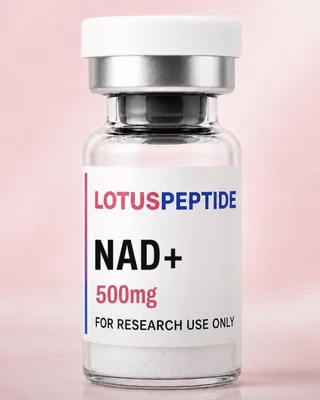
NAD+ 500mg
NAD+ (nicotinamide adenine dinucleotide, oxidized form) is a coenzyme, not a peptide. It is a dinucleotide: a nicotinamide nucleotide and an adenine nucleotide joined through a pyrophosphate bridge. FDA has not approved NAD+ as a drug, and this product is intended only for laboratory research.
- Single Vial$30
- 5-Pack (5 vials)$26 per vial$130
- 10-Pack (10 vials)$23.50 per vial Lowest per vial$235
Ships from the United States within 1 business day. Laboratory research use only.
At a glance
- Strength
- 500 mg
- Also known as
- Nicotinamide adenine dinucleotide; beta-NAD; nadide; coenzyme I; diphosphopyridine nucleotide
- CAS number
- 53-84-9
- Molecular formula
- C21H27N7O14P2
- Molecular weight
- 663.4 g/mol
- PubChem CID
- 5892
What NAD+ is
NAD+ is a small-molecule coenzyme with no amino acids and no peptide bonds, so peptide terms such as sequence do not apply to it. It is the oxidized partner of the NAD+/NADH redox couple, and its phosphorylated relative forms a second couple, NADP+/NADPH 1. In metabolism it accepts and donates hydride in redox reactions and also serves as a substrate for sirtuins and other NAD+-consuming enzymes 2. Its structure joins nicotinamide riboside and adenosine through two phosphate groups, as PubChem's IUPAC name for CID 5892 shows. The biologically used form is the beta anomer, which is why catalogs often write beta-NAD. Older names include nadide, coenzyme I and diphosphopyridine nucleotide, all listed as synonyms in PubChem. NAD+ is also distinct from precursors such as nicotinamide riboside (NR) and nicotinamide mononucleotide (NMN) 3.
Regulatory status
No drug product with NAD+ as its active ingredient is FDA-approved; Drugs@FDA has no match under nadide or nicotinamide adenine dinucleotide. Separately, FDA keeps lists of substances nominated for pharmacy compounding under section 503A. On FDA's list updated May 14, 2026, nicotinamide adenine dinucleotide (NAD) sits in category 1, substances under evaluation. The disodium salt trihydrate of beta-NAD appears separately in category 3, substances nominated without adequate support. Both listings concern compounding nominations and neither is an approval. The NAD+ on this page is sold as a laboratory chemical, not as a medicine or supplement.
Published research
Research on NAD+ is extensive at the level of biochemistry and cell biology. A 2021 perspective described roles beyond redox chemistry, including signaling, post-translational modification, epigenetic change and NAD-capping of RNA. It also noted that NAD has a half-life of minutes in some tissues 4. A 2018 review described how cells keep NAD(H) and NADP(H) in separate compartmental pools 1. A 2024 review listed open questions, including the gut microbiome's role in NAD+ precursor availability and the need for better detection of NAD+ in specific cells and compartments 3. Human studies have also examined NAD+ itself. A 2019 pilot study in people measured NAD+ and its metabolites in plasma and urine while NAD+ was administered over six hours. The authors reported no change in plasma NAD+ or its measured metabolites for the first two hours, and they found NAD+ and methylnicotinamide in urine 5.
What is not known
This page does not review clinical trials of NAD+, and the studies named above are examples, not a complete count. As of the 2019 and 2021 papers cited here, basic questions about the fate of administered NAD+ in people and the transport of NAD and its precursors into cells were listed as open. In 2019, investigators noted that no data were available on the fate of administered NAD+ in a human cohort 5. Their pilot then reported that administered NAD+ was rapidly removed from plasma during the first two hours, with a metabolite profile consistent with NAD+ glycohydrolase and pyrophosphatase activity 5. The 2021 perspective listed how NAD and its precursors are transported into cells and organelles as an open question 4. Measurement is a further limit. Reliable quantification of NAD+ and related metabolites in complex samples needs mass spectrometry 2, and compartment-level measurement is still a research problem 3.
Laboratory storage and handling
Store dry NAD+ as stated on its certificate of analysis and product label. In solution, its stability depends strongly on buffer and temperature. A 2024 study held NAD+ and NADH for up to 43 days in sodium phosphate, HEPES and Tris buffers at 19 and 25 degrees C. Both were most stable in Tris, degradation was faster in phosphate and HEPES, and the small rise in temperature had a significant effect 6. The authors also noted that degradation of NADH can be followed by UV-Vis spectroscopy, because it proceeds through oxidation of the dihydropyridine ring 6.
Quality testing
An NAD+ certificate of analysis should show:
- Identity: mass spectrometry consistent with NAD+ (C21H27N7O14P2, 663.4 g/mol for the free acid).
- Purity: HPLC. LC-MS methods were developed because HPLC with UV detection lacks the specificity and sensitivity needed for complex biological samples 2. For a single purified material, the certificate should state which detector was used.
- Related substances: the reduced form NADH and breakdown products such as nicotinamide and ADP-ribose.
- Form: free acid or sodium salt, plus water content, because each changes how much NAD+ a weighed milligram contains.
Peptide tests such as amino acid analysis do not apply. Each lot's own certificate carries its purity result.
Questions
Is NAD+ a peptide?
No. NAD+ is a coenzyme made of two nucleotides joined by a pyrophosphate bridge. It contains no amino acids. It is sold alongside research peptides, but its chemistry, testing and stability are those of a nucleotide.
What is the difference between NAD+ and NADH?
They are the oxidized and reduced forms of the same coenzyme, which together make up a redox couple 1. NAD+ accepts a hydride in redox reactions and becomes NADH 2. A certificate for NAD+ should report how much NADH, if any, is present as a related substance.
How do NAD+, NR and NMN differ?
NR (nicotinamide riboside) and NMN (nicotinamide mononucleotide) are precursors of NAD+ 3. They are different compounds with their own chemical identities, and a certificate for NAD+ does not cover them.
References
- Xiao W, Wang RS, Handy DE, et al. NAD(H) and NADP(H) Redox Couples and Cellular Energy Metabolism. Antioxid Redox Signal. 2018. pubmed.ncbi.nlm.nih.gov
- Trammell SA, Brenner C. Targeted, LCMS-based Metabolomics for Quantitative Measurement of NAD(+) Metabolites. Comput Struct Biotechnol J. 2013. pubmed.ncbi.nlm.nih.gov
- Migaud ME, Ziegler M, Baur JA. Regulation of and challenges in targeting NAD(+) metabolism. Nat Rev Mol Cell Biol. 2024. pubmed.ncbi.nlm.nih.gov
- Chini CCS, Zeidler JD, Kashyap S, et al. Evolving concepts in NAD(+) metabolism. Cell Metab. 2021. pubmed.ncbi.nlm.nih.gov
- Grant R, Berg J, Mestayer R, et al. A Pilot Study Investigating Changes in the Human Plasma and Urine NAD+ Metabolome During a 6 Hour Intravenous Infusion of NAD. Front Aging Neurosci. 2019. pubmed.ncbi.nlm.nih.gov
- Wolfe KD, Alahuhta M, Himmel ME, et al. Long-Term Stability of Nicotinamide Cofactors in Common Aqueous Buffers: Implications for Cell-Free Biocatalysis. Molecules. 2024. pubmed.ncbi.nlm.nih.gov
This page summarises published laboratory research and cites its sources. It is not medical advice and makes no claim that the compound treats, cures or prevents any condition. LotusPeptide sells it for laboratory research use only.
Shipping and returns
- Shipping
- Orders are processed and shipped within 1 business day.
- Returns
- Returns are not accepted.
- Damaged or lost items
- Replacements and refunds are offered on damaged or lost items.