In stock
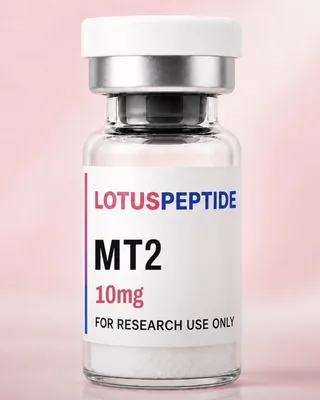
Melanotan II 10mg
Melanotan II is a synthetic, lactam-bridged cyclic heptapeptide analog of alpha-melanocyte-stimulating hormone (alpha-MSH), developed by a University of Arizona research group. It is not approved by the FDA for any use.
- Single Vial$25
- 5-Pack (5 vials)$22 per vial$110
- 10-Pack (10 vials)$20 per vial Lowest per vial$200
Ships from the United States within 1 business day. Laboratory research use only.
At a glance
- Strength
- 10 mg
- Also known as
- MT-II, MTII, Melanotan-II
- CAS number
- 121062-08-6
- Molecular formula
- C50H69N15O9
- Molecular weight
- 1024.2 g/mol
- Sequence
- Ac-Nle-cyclo[Asp-His-D-Phe-Arg-Trp-Lys]-NH2
- PubChem CID
- 92432
What melanotan II is
Melanotan II (MT-II) is a shortened, ring-closed version of the alpha-MSH 4-10 region. The Arizona group described two analogs: a linear peptide, melanotan I, and a cyclic truncated peptide, melanotan II 1. The published structure is Ac-Nle4-Asp5-His6-D-Phe7-Arg8-Trp9-Lys10 alpha-MSH4-10-NH2 2. Three design features set it apart from the natural hormone. The N-terminus is acetylated norleucine, position 7 carries D-phenylalanine in place of the natural L-form, and the C-terminus is an amide. The ring is a lactam bond between the side-chain carboxyl of aspartic acid and the epsilon-amino group of lysine 3. A 2008 paper reported the first preparative solution-phase synthesis of the molecule 3. Common synonyms are MT-II, MTII and melanotan-II.
Related melanocortin peptides that are different molecules
Two other alpha-MSH analogs are closely related to melanotan II, and the three are not interchangeable. PubChem lists afamelanotide as [Nle4, D-Phe7]-alpha-MSH, a linear 13-residue peptide with the formula C78H111N21O19 and the synonym Melanotan. Bremelanotide, studied as PT-141, was developed as an analog of melanotan II 1. PubChem gives it the same ring and side chains but a free carboxylic acid at the C-terminus where melanotan II has an amide (C50H68N14O10 versus C50H69N15O9). That single change is why the two differ by less than one mass unit. Published data, labels and approvals for afamelanotide or bremelanotide describe those molecules only and say nothing directly about melanotan II.
Regulatory status
Melanotan II is not an FDA-approved drug and has no listing in Drugs@FDA. On or about August 30, 2007, FDA sent a warning letter to a company marketing melanotan II through a website. According to FDA's account of the case in a 2016 notice, the letter stated that, based on information and statements on that company's website, melanotan II constituted a new drug that could not be introduced into interstate commerce without an FDA-approved application. A November 2007 FDA letter to the company's attorney reiterated that FDA considered it an unapproved drug. Separately, FDA's page on bulk substances that may present significant safety risks lists melanotan II among compounding nominations that were withdrawn. That entry cites possible immunogenicity from aggregation or peptide-related impurities and published case reports of serious adverse events. Two related molecules are approved. Scenesse (afamelanotide) is held by Clinuvel under NDA 210797, approved October 8, 2019. Vyleesi (bremelanotide) is held by Cosette Pharmaceuticals under NDA 210557, approved June 21, 2019. Their approved indications are set out in the FDA labels (Scenesse label, Vyleesi label), and neither product contains melanotan II. A 2017 review noted that afamelanotide had been tested formally while unregulated melanotans had not 4. This store sells melanotan II only as a laboratory research material, not as a medicine.
Published research
The human study cited on this page is a 1996 pilot. That phase I study administered melanotan II or saline on alternating days to three healthy male volunteers in a single-blind, placebo-controlled design 2. The investigators measured skin reflectance and recorded adverse events 2. In animal and in vitro work, one study characterized nine melanocortin ligands on cloned rat MC3 and MC4 receptors and reported that melanotan II, when administered to rats, induced grooming behavior 5. A separate literature consists of case reports in people who obtained melanotan outside any trial. A 2017 review summarized reports of changes in existing moles and new nevi, plus four melanoma cases. Its authors stated that conclusive evidence linking these events to melanotan was lacking 4.
What is not known
The human data cited here are small and early, and this page found no large controlled trial of melanotan II in PubMed. Long-term safety in people has not been studied in any structured way. Case reports cannot show cause and effect, so the significance of the reported skin findings remains unresolved 4. The composition of material sold under the name is also uncertain. A 2018 review from a Belgian medicines laboratory lists melanotan II among falsified peptide products. The review also notes, for falsified polypeptide drugs in general, reports of the wrong active ingredient, the wrong amount, or no active ingredient at all 6. A forensic laboratory in Liege that analyzed vials labeled melanotan II determined the purity of the powder at 30% 7. These findings describe the products tested in those studies, not material from any other source.
Quality testing
Two analytical points matter most for melanotan II: confirming the right molecule and measuring how much of it is present. Routine forensic screening can miss it. In the Liege case, no library match was found by HPLC-DAD, the 1024 Da peptide sat near the upper mass limit some instruments are set for, and its multiply charged ions were unusual for that laboratory. Identification was confirmed only against a reference standard 7. PubChem's monoisotopic masses for melanotan II and bremelanotide differ by only about 0.98 Da, so low-resolution data may not separate them. Given that small gap, this page regards accurate-mass data checked against a reference standard as the sensible choice when the two must be told apart. A useful certificate also states HPLC purity, net peptide content per vial, the counter-ion, appearance, and the lot and test date. Lot-specific numbers belong on the certificate, not in this article.
Questions
Is melanotan II the same as afamelanotide or bremelanotide?
No. Afamelanotide is a linear 13-residue alpha-MSH analog, listed in PubChem with the synonym Melanotan. Bremelanotide shares melanotan II's ring but ends in a carboxylic acid instead of an amide. All three have different formulas, PubChem records and regulatory histories.
Is melanotan II approved by the FDA?
No. It has no Drugs@FDA listing. In a 2007 warning letter to one company that marketed it online, FDA stated that, based on that company's website, melanotan II was a new drug that needed an FDA-approved application before interstate sale. The approved products Scenesse and Vyleesi contain afamelanotide and bremelanotide, not melanotan II.
How can a laboratory confirm that a vial contains melanotan II and not bremelanotide?
Accurate-mass LC-MS against a reference standard is the practical route. The monoisotopic masses listed in PubChem are 1023.540 Da for melanotan II and 1024.524 Da for bremelanotide, a gap of about 0.98 Da that low-resolution instruments can blur. Fragment ions and retention time add confirmation.
References
- Hadley ME, Dorr RT. Melanocortin peptide therapeutics: historical milestones, clinical studies and commercialization. Peptides. 2006. pubmed.ncbi.nlm.nih.gov
- Dorr RT, Lines R, Levine N, et al. Evaluation of melanotan-II, a superpotent cyclic melanotropic peptide in a pilot phase-I clinical study. Life Sci. 1996. pubmed.ncbi.nlm.nih.gov
- Ryakhovsky VV, Khachiyan GA, Kosovova NF, et al. The first preparative solution phase synthesis of melanotan II. Beilstein J Org Chem. 2008. pubmed.ncbi.nlm.nih.gov
- Habbema L, Halk AB, Neumann M, et al. Risks of unregulated use of alpha-melanocyte-stimulating hormone analogues: a review. Int J Dermatol. 2017. pubmed.ncbi.nlm.nih.gov
- Adan RA, Szklarczyk AW, Oosterom J, et al. Characterization of melanocortin receptor ligands on cloned brain melanocortin receptors and on grooming behavior in the rat. Eur J Pharmacol. 1999. pubmed.ncbi.nlm.nih.gov
- Janvier S, De Spiegeleer B, Vanhee C, et al. Falsification of biotechnology drugs: current dangers and/or future disasters? J Pharm Biomed Anal. 2018. pubmed.ncbi.nlm.nih.gov
- Deville M, Charlier C. Barbie drug identification: Not a child's play. J Forensic Sci. 2024. pubmed.ncbi.nlm.nih.gov
This page summarises published laboratory research and cites its sources. It is not medical advice and makes no claim that the compound treats, cures or prevents any condition. LotusPeptide sells it for laboratory research use only.
Shipping and returns
- Shipping
- Orders are processed and shipped within 1 business day.
- Returns
- Returns are not accepted.
- Damaged or lost items
- Replacements and refunds are offered on damaged or lost items.