Low stock
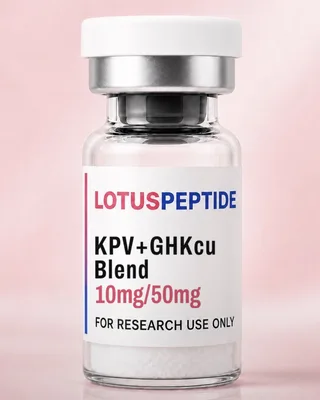
KPV+GHK-Cu Blend 10mg/50mg
This product combines two different tripeptides: KPV (Lys-Pro-Val), 10 mg, and GHK-Cu (the copper(II) complex of Gly-His-Lys), 50 mg. No published study has examined this combination. Neither component is approved by FDA as a drug; the blend is sold only for laboratory research.
- Single Vial$30
- 5-Pack (5 vials)$27 per vial$135
- 10-Pack (10 vials)$25 per vial Lowest per vial$250
Ships from the United States within 1 business day. Laboratory research use only.
At a glance
- Also known as
- KPV + GHK-Cu; Lys-Pro-Val with copper tripeptide-1
- CAS number
- 67727-97-3 (KPV); 89030-95-5 (GHK-Cu)
- Molecular formula
- C16H30N4O4 (KPV); C14H23CuN6O4+ (GHK-Cu)
- Molecular weight
- 342.43 g/mol (KPV); 402.92 g/mol (GHK-Cu)
- Sequence
- Lys-Pro-Val (KPV) and Gly-His-Lys complexed with copper(II) (GHK-Cu), as two separate tripeptides
- PubChem CID
- 125672 (KPV); 71587328 (GHK-Cu)
What the blend contains
The blend combines two unrelated tripeptides at a 1:5 ratio by mass. By moles the balance is different. Using PubChem molecular weights (342.43 g/mol for KPV, CID 125672, and 402.92 g/mol for the 1:1 copper complex, CID 71587328), 10 mg of KPV is about 29 micromoles and 50 mg of GHK-Cu about 124 micromoles. That is roughly four GHK-Cu molecules for each KPV molecule. Salts, water and any 2:1 copper complex would shift these figures, so only the batch certificate can give the real content of each component. The two compounds have their own pages on this site, which cover identity, research and regulatory detail. This page covers only what changes when they are combined in one product.
What has been published on the combination
Nothing has been published on KPV and GHK-Cu together. A PubMed search on October 2, 2026 for KPV, Lys-Pro-Val or alpha-MSH 11-13 combined with GHK, GHK-Cu, Gly-His-Lys or copper tripeptide returned two records. One was a review that discusses the two compounds as separate lines of work, and the other was an unrelated protein-sequencing paper. Any reason for combining the two in one product therefore comes from separate literature on each compound, not from data on the mixture. Whether the two peptides behave differently together than apart, chemically or biologically, is unknown.
Why a two-peptide mixture is analyzed differently
A single purity percentage cannot describe this product. A certificate should report each component separately:
- Identity of each component by mass spectrometry, matching KPV and the GHK peptide.
- Content of each component against the label (10 mg and 50 mg), since a mixture can be pure and still have the wrong ratio.
- Purity of each component by HPLC, with both peaks resolved. A validated reverse-phase method already exists for KPV 1; the run must also separate it from GHK.
- Copper content by an elemental method such as ICP-MS, because GHK binds copper(II) at an apparent pK of about 3.6 2, so an HPLC run at strongly acidic pH, below that value, mainly measures free peptide rather than the intact complex.
The KPV and GHK-Cu pages describe each component's own degradation products and test methods.
Possible interaction between the components
Interaction between the two components has not been studied, but the chemistry gives reason to check. Copper bound to GHK is not the only possible arrangement: in solution GHK can form mixed (ternary) copper complexes with other ligands such as the amino acid histidine 3. The same study found that the lysine epsilon-amino group of GHK raises the stability of its copper complexes 3. Free amine groups of that kind are also present in KPV, which has an N-terminal amine and a lysine side chain. Whether KPV binds any copper in this mixture, in the solid state or in solution, has not been studied. A copper speciation method would be needed to find out.
Regulatory status and handling
Neither KPV nor GHK-Cu appears in Drugs@FDA, and FDA has approved no drug containing either one. Both compounds appear in FDA's bulk-substance categories for pharmacy compounding, and neither listing is an approval. A mixture of the two has no regulatory standing of its own; it is a research material, not a medicine. For handling, store the material as its certificate of analysis and product label direct. Slow solid-state reactions such as peptide bond cleavage and oxidation depend on temperature and moisture content 4, and a two-component material gives them two substrates. Each component page lists its own specific weak points.
Questions
Has the KPV and GHK-Cu combination been studied?
No. A PubMed search in October 2026 found no study of the two compounds together. Published work covers each one separately.
How should purity be reported for a two-peptide mixture?
Separately for each component. The certificate should confirm the identity of KPV and GHK by mass spectrometry, give the measured content of each against the label, report HPLC purity for each resolved peak and give copper content from an elemental method. A single overall percentage hides the ratio.
Why does the molar ratio differ from the 1:5 mass ratio?
GHK-Cu is heavier per molecule than KPV (402.92 versus 342.43 g/mol in PubChem), and the masses differ fivefold. By moles that works out to roughly four GHK-Cu molecules per KPV, before allowing for salts and water.
References
- Pawar KR, Mulabagal V, Smith F, et al. Stability-indicating HPLC assay for lysine-proline-valine (KPV) in aqueous solutions and skin homogenates. Biomed Chromatogr. 2015. pubmed.ncbi.nlm.nih.gov
- Freedman JH, Pickart L, Weinstein B, et al. Structure of the Glycyl-L-histidyl-L-lysine--copper(II) complex in solution. Biochemistry. 1982. pubmed.ncbi.nlm.nih.gov
- Lau SJ, Sarkar B. The interaction of copper(II) and glycyl-L-histidyl-L-lysine, a growth-modulating tripeptide from plasma. Biochem J. 1981. pubmed.ncbi.nlm.nih.gov
- Lai MC, Topp EM. Solid-state chemical stability of proteins and peptides. J Pharm Sci. 1999. pubmed.ncbi.nlm.nih.gov
This page summarises published laboratory research and cites its sources. It is not medical advice and makes no claim that the compound treats, cures or prevents any condition. LotusPeptide sells it for laboratory research use only.
Shipping and returns
- Shipping
- Orders are processed and shipped within 1 business day.
- Returns
- Returns are not accepted.
- Damaged or lost items
- Replacements and refunds are offered on damaged or lost items.