Low stock
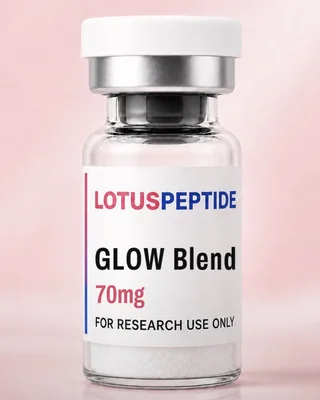
GLOW Blend 70mg
GLOW is a three-component peptide blend: 10 mg BPC-157, 10 mg TB-500 and 50 mg GHK-Cu, the copper(II) complex of the tripeptide GHK, in one vial. No component is an FDA-approved drug, no approved product contains this mixture, and the blend is sold only as a laboratory research material.
- Single Vial$50
- 5-Pack (5 vials)$42 per vial$210
- 10-Pack (10 vials)$38.50 per vial Lowest per vial$385
Ships from the United States within 1 business day. Laboratory research use only.
At a glance
- Strength
- 70 mg
What is in a GLOW vial
Each vial holds 70 mg of labelled material in three components. GHK-Cu is most of it.
- GHK-Cu, 50 mg (about 71% of the labelled mass). Glycyl-L-histidyl-L-lysine bound to copper(II). PubChem's 1:1 record (CID 71587328) gives 402.92 g/mol, so 50 mg is roughly 124 micromoles. See the GHK-Cu article.
- BPC-157, 10 mg (about 14%). The 15-residue peptide GEPPPGKPADDAGLV, 1419.5 g/mol, about 7.0 micromoles. See the BPC-157 article.
- TB-500, 10 mg (about 14%). About 11.2 micromoles if it is the seven-residue acetylated fragment (889.0 g/mol), or 2.0 micromoles if it is full-length thymosin beta-4 (4,963 g/mol). Products under this name have not been consistent 1. See the TB-500 article.
In molar terms GHK-Cu outnumbers BPC-157 about 18 to 1. These figures take each labelled mass as the free peptide or complex. Acetate or other counterions in any component would lower the true amounts.
An open question: copper next to other peptides
Whether the copper in GHK-Cu interacts with BPC-157 or TB-500 has not been studied, in a vial or in solution. The question arises from work in other systems, and none of that work involved this mixture. In protein crystals carrying a GHK tag fused to a GFP variant, side chains of neighbouring molecules, including histidine and aspartate, completed the copper's coordination 2. In solution, copper-GHK formed ternary complexes with histidine side chains of human serum albumin 3. BPC-157 and both forms of TB-500 lack histidine, though they carry acidic side chains. A separate model study used a prion-protein peptide containing both histidine and methionine. With copper(II) or iron(III) and hydrogen peroxide added, its methionine and histidine side chains were oxidised 4. Of the GLOW components, only full-length thymosin beta-4 has a methionine, at position 6, and it has no histidine, so that model is not a close analogue. Its methionine sulfoxide form binds actin more weakly than the native protein 5. These reports explain why the question is asked; they are not evidence that any such reaction occurs in GLOW.
How the blend is analysed and certified
A GLOW certificate has to report three components and a metal, not one purity figure. Because GHK-Cu is about 71% of the mass, the BPC-157 and TB-500 peaks are small beside it. Their impurities can fall near the detection limit unless the method is tuned for them. Each peptide's content should be measured against its own reference standard. Mass spectrometry should confirm all three identities. BPC-157 appears near m/z 1419.7 and Ac-LKKTETQ near 889.5. GHK-Cu appears near m/z 402.1 while the complex stays intact, with the paired peaks of the two natural copper isotopes, or as free GHK near 341.2 if the copper dissociates during analysis. Copper itself should be measured by an elemental method. As a check, copper is about 15.8% of the 1:1 complex, so 50 mg of it carries roughly 7.9 mg of copper. A 2:1 bis-complex (PubChem CID 9831891, 742.3 g/mol) would carry about 4.3 mg. The certificate should say which form the batch is. Lot-specific results belong on that certificate.
Published research on the combination
No study of this three-component combination was found. PubMed searches on October 3, 2026, for GHK together with BPC-157 terms, and for GHK together with thymosin or TB-500 terms, each returned the same seven records. None of the seven abstracts describes a study of the combination; they are narrative or scoping reviews of peptide therapies. Searches for "GLOW" or "KLOW" with peptide terms found nothing relevant. The literature on BPC-157 with TB-500 alone is discussed in the BPC-157 and TB-500 blend article. Research on each GHK-Cu, BPC-157 and TB-500 component is summarised in its own article.
Regulatory status
No FDA-approved drug contains GHK-Cu, BPC-157, TB-500 or this combination. The July 23, 2026 meeting of FDA's Pharmacy Compounding Advisory Committee included BPC-157 and TB-500 among substances considered for the 503A bulks list. FDA had published no minutes or decision from it as of October 3, 2026. FDA's briefing documents for that meeting evaluate BPC-157 and TB-500 separately. GLOW is offered for laboratory research only and is not a medicine.
What is not known
The open questions for GLOW are mostly chemical. No published data show whether the copper in GHK-Cu interacts with BPC-157 or TB-500 in the vial or after dissolution. Nor do they show whether copper affects the stability of the other components over storage. The stoichiometry of the GHK-Cu used, 1:1 or 2:1, and its counterions are not fixed by the name. The identity of the TB-500 component also has to be confirmed 1. There is no stability study of the mixture, so it should be stored as stated on the certificate of analysis and the product label. There is no controlled study of the three substances together in any model.
Questions
What is the exact composition of GLOW?
Each vial contains 10 mg BPC-157, 10 mg TB-500 and 50 mg GHK-Cu, 70 mg of labelled material in total. By number of molecules GHK-Cu is the large majority, roughly 18 molecules for each BPC-157 molecule.
Why does the certificate for GLOW report copper?
GHK-Cu contributes the copper, and its amount shows which copper complex is present. Roughly 7.9 mg of copper per vial is expected for 50 mg of the 1:1 complex, and roughly 4.3 mg for the 2:1 bis-complex.
Has the GLOW combination been studied?
No primary study of BPC-157, TB-500 and GHK-Cu together was found in PubMed on October 3, 2026. The records that mention these peptides together are reviews.
References
- Delcourt V, Garcia P, Chabot B, et al. TB500/TB1000 and SGF1000: A scientific approach for a better understanding of misbranded and adulterated drugs. Drug Test Anal. 2023. pubmed.ncbi.nlm.nih.gov
- Mehr A, Henneberg F, Chari A, et al. The copper(II)-binding tripeptide GHK, a valuable crystallization and phasing tag for macromolecular crystallography. Acta Crystallogr D Struct Biol. 2020. pubmed.ncbi.nlm.nih.gov
- Bossak-Ahmad K, Bal W, Frączyk T, et al. Ternary Cu(2+) Complexes of Human Serum Albumin and Glycyl-l-histidyl-l-lysine. Inorg Chem. 2021. pubmed.ncbi.nlm.nih.gov
- Bodnár N, Várnagy K, Nagy L, et al. Ambivalent role of ascorbic acid in the metal-catalyzed oxidation of oligopeptides. J Inorg Biochem. 2021. pubmed.ncbi.nlm.nih.gov
- Huff T, Zerzawy D, Hannappel E. Interactions of beta-thymosins, thymosin beta 4-sulfoxide, and N-terminally truncated thymosin beta 4 with actin studied by equilibrium centrifugation, chemical cross-linking and viscometry. Eur J Biochem. 1995. pubmed.ncbi.nlm.nih.gov
This page summarises published laboratory research and cites its sources. It is not medical advice and makes no claim that the compound treats, cures or prevents any condition. LotusPeptide sells it for laboratory research use only.
Shipping and returns
- Shipping
- Orders are processed and shipped within 1 business day.
- Returns
- Returns are not accepted.
- Damaged or lost items
- Replacements and refunds are offered on damaged or lost items.