In stock
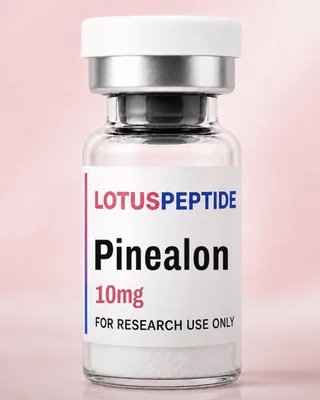
Pinealon 10mg
Pinealon is a synthetic tripeptide, Glu-Asp-Arg (EDR), made of three L-amino acids with a free amine at one end and a free acid at the other. It comes from the St. Petersburg Institute of Bioregulation and Gerontology, where Vladimir Khavinson's group has studied it, mostly in cell cultures and rodents. The FDA has not approved it, and it appears in no FDA drug approval record.
- Single Vial$35
- 5-Pack (5 vials)$29 per vial$145
- 10-Pack (10 vials)$22.50 per vial Lowest per vial$225
Ships from the United States within 1 business day, to the US and the UK and Europe. Laboratory research use only.
Lab results
Certificates for this compound are published on the lab results page as batches are tested.
At a glance
- Strength
- 10 mg
- Also known as
- Glu-Asp-Arg, E-D-R, H-Glu-Asp-Arg-OH, L-Glutamyl-L-aspartyl-L-arginine, glutamyl-aspartyl-arginine
- CAS number
- 175175-23-2
- Molecular formula
- C15H26N6O8
- Molecular weight
- 418.4 g/mol
- Sequence
- Glu-Asp-Arg (EDR)
- PubChem CID
- 10273502
What Pinealon is
Pinealon belongs to what the Khavinson group calls ultrashort peptides, two to four amino acid residues long, which its 2020 review also groups as peptide bioregulators 3. The group describes EDR as a peptide derived from Cortexin, which a 2019 paper calls a clinically approved polypeptide complex from calf cerebral cortex 5. Their 2020 review says the tripeptide was isolated from Cortexin 3, while the 2019 paper says EDR and a second Cortexin derivative were synthesized 5. Either way, the compound PubChem lists with the synonym pinealon is a single defined tripeptide, not a tissue extract 1.
A 2013 review from the same group placed Pinealon among short neuroprotective peptides alongside Semax and Cortagen (spelled kortagen in the abstract) 6. A 2024 review again listed Glu-Asp-Arg with the Semax sequence Met-Glu-His-Phe-Pro-Gly-Pro and other short peptides it described as multitarget agents 7. Selank is another short synthetic peptide from Russian research; a 2001 study at a Moscow mental-health research centre measured it and Semax against enkephalin-degrading enzymes of human serum 8. Their sequences, Thr-Lys-Pro-Arg-Pro-Gly-Pro and Met-Glu-His-Phe-Pro-Gly-Pro, are seven residues long 8.
Chemical identity
PubChem CID 10273502 (titled Glu-Asp-Arg, with pinealon among its synonyms) records the free tripeptide, C15H26N6O8, with a molecular weight of 418.40 g/mol and CAS number 175175-23-2 1. Its IUPAC name places all three stereocentres in the S (L) configuration 1. Two of the three residues are acidic, glutamic acid and aspartic acid, and the third, arginine, carries a guanidino group 1. PubChem's synonyms include H-Glu-Asp-Arg-OH, L-Glutamyl-L-aspartyl-L-arginine and an entry for an acetate salt form 1.
PubChem's molecular weight of 418.40 g/mol is for the free tripeptide; its synonyms also include an acetate salt form 1. PubChem gives a monoisotopic mass of 418.181 Da 1. Published certificates of analysis are listed with our lab results.
Regulatory status
As of October 2026, the FDA has not approved Pinealon, and a search of Drugs@FDA returns no product under that name 4. Pinealon is not named on FDA's list of bulk drug substances nominated for compounding under section 503A, updated May 14, 2026 9. It is not on the corresponding section 503B list, updated March 21, 2025 10. Nor does it appear on FDA's page of bulk drug substances that may present significant safety risks in compounding 11. A search of ClinicalTrials.gov for "pinealon" returns no registered studies 12. Pinealon is supplied here as a laboratory research material, not as a medicine.
Published research
The PubMed literature on Pinealon is small. Most of the papers cited here list Khavinson or colleagues from his institute among the authors, and several are short Russian-language reports 2131415. One exception is a 2019 biophysics paper from Saint Petersburg State University 16.
Cell studies
In cerebellar granule cells, neutrophils and PC12 pheochromocytoma cells exposed to oxidative stress, Pinealon limited the build-up of reactive oxygen species in a concentration-dependent way and reduced necrotic cell death measured by propidium iodide 2. The same 2011 study recorded a delayed time course of ERK 1/2 activation and changes in the cell cycle 2. An earlier 2008 study found that Pinealon and three related peptides showed no direct antioxidant activity but limited lipid peroxidation of human lipoproteins 17. In the same work, Pinealon raised the resting level of intracellular reactive oxygen species while lowering the percentage of dead cells in a neuronal population 17. In ageing cultures of brain cortex cells, EDR increased serotonin expression 18. In organotypic rat pineal gland culture, EDR did not change expression of the apoptosis marker AIF 19.
Several studies used Alzheimer's disease models. In mouse hippocampal neurons exposed to amyloid, EDR increased the number of mushroom-shaped dendritic spines by 71% 20. A 2024 study converted skin fibroblasts from elderly donors into induced cortical neurons 14. EDR, KED and AEDG all increased dendritic branching in these cells 14. The two tripeptides did not change mitochondrial or lysosomal activity or p16 levels, and EDR reduced a marker of oxidative DNA damage 14.
Animal studies
Among four short peptides tested in a hypobaric hypoxia model, Pinealon had the most pronounced antihypoxic effect, according to a 2008 report 21. In rats whose mothers were fed extra methionine during pregnancy to raise homocysteine, Pinealon given to the mothers was followed by better spatial orientation and learning in the offspring 22. Neurons from the offspring's cerebellum showed lower reactive oxygen species accumulation and fewer necrotic cells 22. In old rats under acute hypoxia, a group at Southern Federal University in Rostov-on-Don, with a co-author from the St. Petersburg institute, measured brain caspase-3 and serum interleukin-6 and TNF after Pinealon or Cortexin 2315. A 2015 study by the same authors in 18-month-old rats found Cortexin had a stronger effect than Pinealon on free-radical processes and caspase-3 in the brain 15.
In 5xFAD mice, a transgenic Alzheimer's model, EDR raised CA1 dendritic spine density by 11% 13. It did not change the overall number of mushroom spines, and a trend towards restored long-term potentiation did not reach statistical significance 13.
Studies in people
Human data are limited to small Russian studies 243. One included 32 people aged 41 to 83 with polymorbidity and organic brain syndrome in remission, and compared Pinealon with a second peptide, Vesugen, on biological-age indicators 24. That study also reported prooxidant activity by chemiluminescence and a fall in CD34+ blood cells 24.
Proposed mechanism
The group's working idea is that EDR enters cells and binds DNA or histones to change gene expression 3. Fluorescently labelled Pinealon entered the cytoplasm, nucleus and nucleolus of HeLa cells, and in solution it appeared to bind preferentially to CAG-containing oligonucleotides 25. A physics group at Saint Petersburg State University used spectroscopy, NMR and molecular dynamics to show that EDR can partly enter the major groove of DNA, and that magnesium ions promote the interaction 16. Other support is computational: docking of EDR into DNA promoter regions 13, to histone H1.3 5, and to the LAT1, LAT2 and PEPT1 transporters 26.
What is not known
Most of the studies cited here come from one research network; one outside example is a physical-chemistry study of the peptide's interaction with DNA 16. The antioxidant picture is unsettled: the 2008 study found no direct antioxidant activity 17, while the 2011 study refers to Pinealon's known antioxidant activity 2. Evidence that EDR acts on particular genes comes from docking models 135 and from binding to DNA in solution 2516; this page found no study that measured EDR bound to a gene inside living cells. No registered clinical trial was found 12, and the human reports are small and mostly in Russian 243.
Questions
Is Pinealon the same as the EDR peptide?
Yes. Pinealon is the name the Khavinson group uses for the tripeptide Glu-Asp-Arg, abbreviated EDR, and PubChem lists pinealon and Glu-Asp-Arg as synonyms on the same record, CID 10273502 13.
Is Pinealon approved by the FDA?
No. As of October 2026 there is no Pinealon product in Drugs@FDA 4, and the name does not appear on FDA's lists of bulk drug substances nominated for compounding under sections 503A and 503B 910.
Is Pinealon the same as Cortexin?
No. Cortexin is a polypeptide complex prepared from calf cerebral cortex, while Pinealon is a single synthetic tripeptide that the Khavinson group describes as a Cortexin derivative 5. Two rat studies compared the two directly and reported different results for each 2315.
Does Pinealon act on the pineal gland?
The published work is mostly on neurons, not the pineal gland 3. In the one organotypic rat pineal culture study found, EDR did not change expression of the apoptosis marker AIF, and only the peptide Ala-Glu-Asp-Gly stimulated CGRP synthesis by pinealocytes 19.
Has Pinealon been studied in people?
Only in small studies, mostly published in Russian. One study included 32 adults aged 41 to 83 24, and ClinicalTrials.gov lists no registered trials under the name 12.
Does LotusPeptide ship Pinealon to the UK and Europe?
Yes. Pinealon ships from the United States to the United Kingdom and 13 EU countries by UPS Worldwide Express: $55 flat for a standard package, typically 2 to 5 days in transit. Import VAT, duties and fees are paid by the recipient on delivery, and orders to the UK and Europe are paid in cryptocurrency at checkout. Details are on the UK and Europe page.
Is there a certificate of analysis for Pinealon?
Not yet. No batch certificate for Pinealon is published at the moment. Certificates are added to the lab results page as each batch is tested.
References
- Glu-Asp-Arg (Pinealon). PubChem Compound Summary for CID 10273502. National Center for Biotechnology Information. pubchem.ncbi.nlm.nih.gov
- Khavinson V, Ribakova Y, Kulebiakin K, et al. Pinealon increases cell viability by suppression of free radical levels and activating proliferative processes. Rejuvenation Res. 2011. pubmed.ncbi.nlm.nih.gov
- Khavinson V, Linkova N, Kozhevnikova E, et al. EDR Peptide: Possible Mechanism of Gene Expression and Protein Synthesis Regulation Involved in the Pathogenesis of Alzheimer's Disease. Molecules. 2020. pubmed.ncbi.nlm.nih.gov
- Drugs@FDA: FDA-Approved Drugs. U.S. Food and Drug Administration. www.accessdata.fda.gov
- Kuznik BI, Davydov SO, Popravka ES, et al. [Epigenetic Mechanisms of Peptide-Driven Regulation and Neuroprotective Protein FKBP1b]. Mol Biol (Mosk). 2019. pubmed.ncbi.nlm.nih.gov
- Umnov RS, Lin'kova NS, Khavinson VKh. [Neuroprotective effects of peptides bioregulators in people of various age]. Adv Gerontol. 2013. pubmed.ncbi.nlm.nih.gov
- Ilina AR, Popovich IG, Ryzhak GA, et al. [Prospects for use of short peptides in pharmacotherapeutic correction of Alzheimer's disease.]. Adv Gerontol. 2024. pubmed.ncbi.nlm.nih.gov
- Kost NV, Sokolov OIu, Gabaeva MV, et al. [Semax and selank inhibit the enkephalin-degrading enzymes from human serum]]. Bioorg Khim. 2001. pubmed.ncbi.nlm.nih.gov
- Bulk Drug Substances Nominated for Use in Compounding Under Section 503A of the Federal Food, Drug, and Cosmetic Act (updated May 14, 2026). U.S. Food and Drug Administration. www.fda.gov
- Bulk Drug Substances Nominated for Use in Compounding Under Section 503B of the Federal Food, Drug, and Cosmetic Act (updated March 21, 2025). U.S. Food and Drug Administration. www.fda.gov
- Certain Bulk Drug Substances for Use in Compounding that May Present Significant Safety Risks. U.S. Food and Drug Administration. www.fda.gov
- ClinicalTrials.gov. Search results for "pinealon". clinicaltrials.gov
- Khavinson V, Ilina A, Kraskovskaya N, et al. Neuroprotective Effects of Tripeptides-Epigenetic Regulators in Mouse Model of Alzheimer's Disease. Pharmaceuticals (Basel). 2021. pubmed.ncbi.nlm.nih.gov
- Kraskovskaya N, Linkova N, Sakhenberg E, et al. Short Peptides Protect Fibroblast-Derived Induced Neurons from Age-Related Changes. Int J Mol Sci. 2024. pubmed.ncbi.nlm.nih.gov
- Mendzheritsky AM, Karantysh GV, Ryzhak GA, et al. [Pinealon and Cortexin influence on behavior and neurochemical processes in 18-month aged rats within hypoxia and hypothermia]. Adv Gerontol. 2015. pubmed.ncbi.nlm.nih.gov
- Silanteva IA, Komolkin AV, Morozova EA, et al. Role of Mono- and Divalent Ions in Peptide Glu-Asp-Arg-DNA Interaction. J Phys Chem B. 2019. pubmed.ncbi.nlm.nih.gov
- Kozina LS, Arutiunian AV, Stvolinskiĭ SL, et al. [Biological activity of regulatory peptides in model experiments in vitro]. Adv Gerontol. 2008. pubmed.ncbi.nlm.nih.gov
- Khavinson VKh, Lin'kova NS, Tarnovskaya SI, et al. Short peptides stimulate serotonin expression in cells of brain cortex. Bull Exp Biol Med. 2014. pubmed.ncbi.nlm.nih.gov
- Khavinson VKh, Linkova NS, Chalisova NI, et al. Effect of short peptides on expression of signaling molecules in organotypic pineal cell culture. Bull Exp Biol Med. 2011. pubmed.ncbi.nlm.nih.gov
- Kraskovskaya NA, Kukanova EO, Lin'kova NS, et al. Tripeptides Restore the Number of Neuronal Spines under Conditions of In Vitro Modeled Alzheimer's Disease. Bull Exp Biol Med. 2017. pubmed.ncbi.nlm.nih.gov
- Kozina LS. [Investigation of antihypoxic properties of short peptides]. Adv Gerontol. 2008. pubmed.ncbi.nlm.nih.gov
- Arutjunyan A, Kozina L, Stvolinskiy S, et al. Pinealon protects the rat offspring from prenatal hyperhomocysteinemia. Int J Clin Exp Med. 2012. pubmed.ncbi.nlm.nih.gov
- Mendzheritskiĭ AM, Karantysh GV, Ryzhak GA, et al. [Regulation of content of cytokines in blood serum and of caspase-3 activity in brains of old rats in model of sharp hypoxic hypoxia with Cortexin and Pinealon]. Adv Gerontol. 2014. pubmed.ncbi.nlm.nih.gov
- Meshchaninov VN, Tkachenko EL, Zharkov SV, et al. [EFFECT OF SYNTHETIC PEPTIDES ON AGING OF PATIENTS WITH CHRONIC POLYMORBIDITY AND ORGANIC BRAIN SYNDROME OF THE CENTRAL NERVOUS SYSTEM IN REMISSION]. Adv Gerontol. 2015. pubmed.ncbi.nlm.nih.gov
- Fedoreyeva LI, Kireev II, Khavinson VKh, et al. Penetration of short fluorescence-labeled peptides into the nucleus in HeLa cells and in vitro specific interaction of the peptides with deoxyribooligonucleotides and DNA. Biochemistry (Mosc). 2011. pubmed.ncbi.nlm.nih.gov
- Khavinson VK, Linkova NS, Rudskoy AI, et al. Feasibility of Transport of 26 Biologically Active Ultrashort Peptides via LAT and PEPT Family Transporters. Biomolecules. 2023. pubmed.ncbi.nlm.nih.gov
This page summarises published laboratory research and cites its sources. It is not medical advice and makes no claim that the compound treats, cures or prevents any condition. LotusPeptide sells it for laboratory research use only.
Shipping and returns
- Shipping
- Orders are processed and shipped within 1 business day.
- UK and Europe
- UPS Worldwide Express, $55 flat, typically 2 to 5 days in transit. Countries, VAT and duties
- Returns
- Returns are not accepted.
- Damaged or lost items
- Replacements and refunds are offered on damaged or lost items.