Low stock
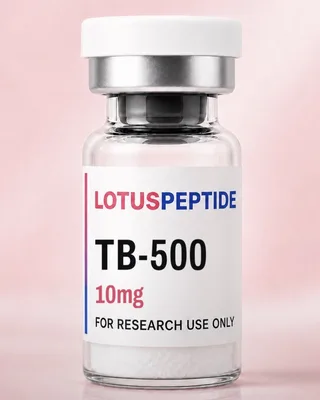
TB-500
Research grade. Lyophilised powder, 10mg per vial.
- Single Vial$32
- 5-Pack (5 vials)$30 per vial$150
- 10-Pack (10 vials)$28 per vial Lowest per vial$280
Ships from the United States within 1 business day. Laboratory research use only.
At a glance
- Strengths
- 5 mg and 10 mg
- Category
- Peptides
TB-500 is a common name, not an official drug name, for research material related to thymosin beta-4, a 43-amino-acid actin-binding protein. FDA and anti-doping laboratories identify it as the acetylated seven-residue fragment Ac-LKKTETQ, but products sold under the name are not consistent. It is not an FDA-approved drug and is sold here only for laboratory research.
What the name TB-500 refers to
FDA notes that TB-500 is a common name and not a United States Adopted Name, so the label does not fix one molecule. FDA's May 2026 briefing document describes TB-500 as understood today to be residues 17 to 23 of thymosin beta-4 with an acetyl group on the first leucine: Ac-Leu-Lys-Lys-Thr-Glu-Thr-Gln-OH. A Ghent anti-doping laboratory identified the N-terminally acetylated 17-23 fragment, Ac-LKKTETQ, in a TB-500 formulation by high-resolution mass spectrometry and then synthesised it 1. A Hong Kong racing laboratory described a veterinary preparation called TB-500 whose key ingredient was N-acetylated LKKTETQ 2. Market material is less consistent. An analysis of products sold online as TB500 and TB1000 found contents not systematically consistent with their earlier descriptions 3. Doping control laboratories have also reported products available online claiming to contain either the acetylated fragment or thymosin beta-4 itself 4. FDA adds that it has encountered several salts and derivatives, including different active moieties, under the same name. Products sold as TB-500 have thus been described as containing either a heptapeptide of about 889 g/mol or a protein of about 4,963 g/mol.
Thymosin beta-4 and the fragment compared
Thymosin beta-4 is an acidic, heat-stable peptide of about 5 kDa, first isolated from calf thymus and shown to be identical to Fx, the peptide that holds most unpolymerised actin in human platelets 5. It forms a 1:1 complex with actin monomers 5. During its biosynthesis the initiator methionine is removed and the amino terminus is acetylated 6. The two molecules sold as TB-500 differ more than fivefold in mass:
- Ac-LKKTETQ (TB-500 in PubChem and FDA usage): PubChem CID 62707662, C38H68N10O14, average molecular weight 889.0 g/mol, monoisotopic mass 888.492 Da, CAS 885340-08-9 for the free peptide. FDA gives the acetate salt as 949.1 g/mol with no CAS of its own, and notes that some suppliers quote the free-base CAS for it.
- Thymosin beta-4: PubChem CID 16132341, C212H350N56O78S, 4,963 g/mol, CAS 77591-33-4, 43 residues: Ac-SDKPDMAEIEKFDKSKLKKTETQEKNPLPSKETIEQEKQAGES. PubChem lists timbetasin as its United States Adopted Name. It has one methionine, at position 6, and no cysteine or histidine.
Counting along that sequence, LKKTETQ occupies positions 17 to 23. The fragment has no methionine, so the oxidation question described below applies only to the full protein.
Regulatory status
No FDA-approved drug contains TB-500 or thymosin beta-4. FDA's 2026 briefing states that neither TB-500 free base nor its acetate is a component of an approved drug or has a USP or NF monograph. It also reports that TB-500 is not in the European or Japanese pharmacopoeias and has no authorised product in the European Union. FDA's Pharmacy Compounding Advisory Committee had TB-500 free base and TB-500 acetate on its July 23, 2026 agenda, as candidates for the section 503A bulks list used by compounding pharmacies. No minutes and no FDA decision had been posted by October 3, 2026. Thymosin beta-4 is prohibited in sport by the World Anti-Doping Agency and by horse racing and equestrian authorities 4. TB-500 sold here is a research chemical for laboratory use, not a medicine.
Published research on the fragment and the protein
Published work on the fragment itself is mainly analytical. Anti-doping laboratories have characterised Ac-LKKTETQ by high-resolution mass spectrometry and proposed methods to detect it in plasma and urine 1. A Hong Kong study identified metabolites of N-acetylated LKKTETQ in vitro and then detected the parent peptide and its metabolites in urine and plasma from horses 2. FDA states that it has not identified any human exposure data for the fragment. The human studies cited here concern the full protein. One is a randomised, placebo-controlled study of synthetic thymosin beta-4 in 40 healthy volunteers, in four cohorts of 10. It recorded treatment-emergent adverse events and pharmacokinetic parameters 7. The other is a first-in-human, randomised, double-blind phase 1 study of a recombinant thymosin beta-4, NL005, in healthy Chinese volunteers. It measured safety, tolerability, pharmacokinetics and anti-drug antibodies 8. Neither study tested the acetylated fragment.
What is not known
FDA's 2026 review found no human exposure data for the acetylated fragment, and no controlled human study of Ac-LKKTETQ is indexed in PubMed. Whether the fragment reproduces the behaviour of the whole protein is not established in the peer-reviewed record cited here. Published work often uses the name loosely. FDA noted that in the sources it reviewed it was often unclear whether TB-500 meant the free base or a salt. A finding reported for TB-500 therefore cannot always be assigned to a single molecule. FDA also found no published data on the impurities or aggregation behaviour of TB-500 bulk material. The two thymosin beta-4 studies tested a different molecule from the fragment and do not describe it 7 8. Which molecule a given product contains is a question for its certificate, since online products have been inconsistent 3.
Laboratory storage and handling
TB-500 should be stored as stated on the certificate of analysis and the product label. FDA's 2026 briefing quotes a supplier data sheet for the free peptide. It gives storage in a sealed container away from moisture and light under nitrogen, for one year at minus 20 °C or two years at minus 80 °C as a powder. A certificate submitted to FDA for the acetate recommended refrigerated or frozen storage in a sealed container. These are supplier statements, not peer-reviewed stability data. If a lot proves to be full-length thymosin beta-4, oxygen exposure is a further consideration. In a biochemical study, oxidation of methionine 6 to the sulfoxide raised the apparent dissociation constant of the actin complex from about 2.5 to 38 to 53 micromolar 9.
Quality testing
The first job of a TB-500 certificate is to state which molecule the batch contains, using mass spectrometry. Ac-LKKTETQ gives a singly protonated ion near m/z 889.5 and a doubly protonated ion near m/z 445.3. Full-length thymosin beta-4, at about 4,963 g/mol, appears as a series of multiply charged ions that deconvolute to that mass. For the fragment, a peak 42 Da lighter than expected would point to a non-acetylated peptide. For the full protein, a peak 16 Da heavier points to methionine sulfoxide, a form with weaker actin binding 9. Purity should be shown by reversed-phase HPLC with the impurity peaks reported. The salt form and acetate content should also be stated. FDA observed in 2026 that a representative public TB-500 certificate listed only appearance, LC-MS identity and HPLC purity. It omitted assay, impurity, aggregate and endotoxin tests. Purity figures belong to each batch's certificate.
Questions
What does TB-500 actually refer to?
In FDA's 2026 review and in anti-doping studies, TB-500 means Ac-LKKTETQ, the N-acetylated residues 17 to 23 of thymosin beta-4 1 2. The name is not an official one, and products sold online under it have claimed to contain either that fragment or full-length thymosin beta-4 4.
How can I tell which molecule a TB-500 vial contains?
Check the mass reported on the certificate of analysis. The acetylated fragment has an average molecular weight of 889.0 g/mol (PubChem CID 62707662), while full-length thymosin beta-4 is about 4,963 g/mol (CID 16132341). A certificate that reports neither mass does not establish identity.
Is TB-500 the same as timbetasin?
Not necessarily. PubChem lists timbetasin as the United States Adopted Name for full-length thymosin beta-4, the 43-residue protein. FDA notes that TB-500 is only a common name and describes it as the seven-residue fragment, so the two names match only when a product labelled TB-500 is in fact the full protein.
References
- Esposito S, Deventer K, Goeman J, et al. Synthesis and characterization of the N-terminal acetylated 17-23 fragment of thymosin beta 4 identified in TB-500, a product suspected to possess doping potential. Drug Test Anal. 2012. pubmed.ncbi.nlm.nih.gov
- Ho EN, Kwok WH, Lau MY, et al. Doping control analysis of TB-500, a synthetic version of an active region of thymosin β₄, in equine urine and plasma by liquid chromatography-mass spectrometry. J Chromatogr A. 2012. pubmed.ncbi.nlm.nih.gov
- Delcourt V, Garcia P, Chabot B, et al. TB500/TB1000 and SGF1000: A scientific approach for a better understanding of misbranded and adulterated drugs. Drug Test Anal. 2023. pubmed.ncbi.nlm.nih.gov
- Delcourt V, Garcia P, Chabot B, et al. Equine Doping Controls of Thymosin β 4: A Population Study and Strategy for Misuse Detection. Drug Test Anal. 2025. pubmed.ncbi.nlm.nih.gov
- Safer D, Elzinga M, Nachmias VT. Thymosin beta 4 and Fx, an actin-sequestering peptide, are indistinguishable. J Biol Chem. 1991. pubmed.ncbi.nlm.nih.gov
- Hannappel E. Thymosin beta4 and its posttranslational modifications. Ann N Y Acad Sci. 2010. pubmed.ncbi.nlm.nih.gov
- Ruff D, Crockford D, Girardi G, et al. A randomized, placebo-controlled, single and multiple dose study of intravenous thymosin beta4 in healthy volunteers. Ann N Y Acad Sci. 2010. pubmed.ncbi.nlm.nih.gov
- Wang X, Liu L, Qi L, et al. A first-in-human, randomized, double-blind, single- and multiple-dose, phase I study of recombinant human thymosin β4 in healthy Chinese volunteers. J Cell Mol Med. 2021. pubmed.ncbi.nlm.nih.gov
- Huff T, Zerzawy D, Hannappel E. Interactions of beta-thymosins, thymosin beta 4-sulfoxide, and N-terminally truncated thymosin beta 4 with actin studied by equilibrium centrifugation, chemical cross-linking and viscometry. Eur J Biochem. 1995. pubmed.ncbi.nlm.nih.gov
This page summarises published laboratory research and cites its sources. It is not medical advice and makes no claim that the compound treats, cures or prevents any condition. LotusPeptide sells it for laboratory research use only.
Shipping and returns
- Shipping
- Orders are processed and shipped within 1 business day.
- Returns
- Returns are not accepted.
- Damaged or lost items
- Replacements and refunds are offered on damaged or lost items.