In stock
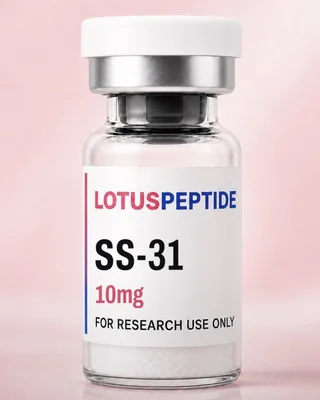
SS-31 10mg
SS-31, also called elamipretide, is a synthetic tetrapeptide (D-Arg-Dmt-Lys-Phe-NH2) from the Szeto-Schiller family of cell-permeable peptides, which bind cardiolipin in the inner mitochondrial membrane. Elamipretide is the active ingredient of Forzinity, which FDA granted accelerated approval in September 2025; the material sold here is a research reagent, not that medicine.
- Single Vial$30
- 5-Pack (5 vials)$26 per vial$130
- 10-Pack (10 vials)$24.50 per vial Lowest per vial$245
Ships from the United States within 1 business day. Laboratory research use only.
Certificate of analysisSS-31 10mg
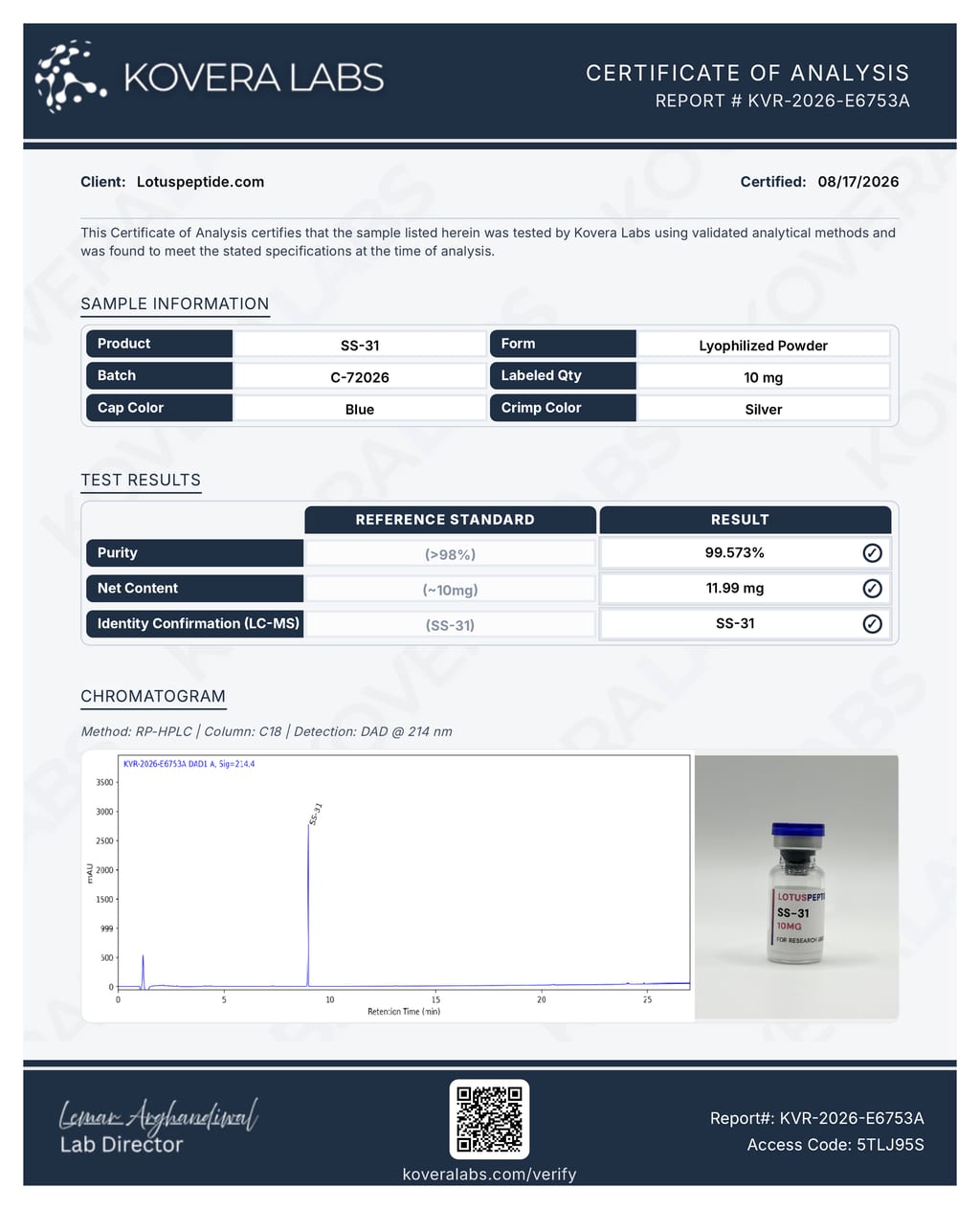
- Batch
- C-72026
- Purity
- 99.57% as reported by the lab
- Tested
- Lab
- Kovera
At a glance
- Strength
- 10 mg
- Also known as
- Elamipretide; MTP-131; Bendavia; SS31; Szeto-Schiller peptide
- CAS number
- 736992-21-5
- Molecular formula
- C32H49N9O5
- Molecular weight
- 639.8 g/mol (free peptide)
- Sequence
- D-Arg-Dmt-Lys-Phe-NH2 (Dmt = 2,6-dimethyl-L-tyrosine)
- PubChem CID
- 11764719
What SS-31 is
SS-31 belongs to a series of short peptides with alternating cationic and aromatic residues that enter cells and target mitochondria 1. The series is known as the Szeto-Schiller peptides, after Szeto and Schiller, who appear together on early papers from Cornell University in New York 2. A 2005 paper by that group studied one related Dmt tetrapeptide, [Dmt1]DALDA, where Dmt is 2,6-dimethyltyrosine. Using isolated mouse liver mitochondria, the authors reported that one fluorescent analog of it was retained in the inner mitochondrial membrane and that the unlabeled parent peptide behaved like that analog 2. SS-31 has carried several names over its development: MTP-131, Bendavia and, as its nonproprietary name, elamipretide. All refer to the same molecule. Stealth BioTherapeutics developed it as a mitochondrial cardiolipin binder 3.
Chemical identity and salt form
PubChem (CID 11764719) gives SS-31 the formula C32H49N9O5, a molecular weight of 639.8 g/mol and CAS number 736992-21-5, all for the free peptide. The four residues are D-arginine, 2,6-dimethyl-L-tyrosine, L-lysine and L-phenylalaninamide. FDA's label for Forzinity describes the drug substance as elamipretide hydrochloride, C32H49N9O5 with three HCl, molecular weight 749.2. Synthetic peptides in general are supplied as hydrochloride, acetate or trifluoroacetate salts. Each salt carries a different counter-ion mass, so the same mass of powder holds different amounts of peptide. A certificate should name the salt and report net peptide content.
Regulatory status
On September 19, 2025, FDA granted accelerated approval to Forzinity (elamipretide), sponsored by Stealth BioTherapeutics under new drug application 215244. The approved indication is set out in the FDA label, available on DailyMed. Under the accelerated approval pathway, the label states that continued approval may depend on a confirmatory trial. The drug substance in Forzinity is elamipretide hydrochloride.
SS-31 sold for research is not Forzinity. It is not made under that application, has not been reviewed by FDA, and is not an approved medicine. It is supplied for laboratory research use only.
Laboratory research
Most laboratory work concerns how SS-31 interacts with mitochondrial membranes. A 2020 study used chemical cross-linking with mass spectrometry in mitochondria to find the proteins SS-31 contacts. The authors identified two groups of interacting proteins, all of them known cardiolipin binders, and mapped the cross-linked residues 4. A 2022 study compared SS-31 with three analogs that differ in aromatic side chains and sequence order. Using NMR and molecular dynamics, the authors built the first structural models for this class and reported that, unlike the analogs, SS-31 did not adopt a compact reverse-turn shape when bound to membranes 1. The same study measured how each peptide bound cardiolipin-containing membranes and changed membrane surface charge 1.
Clinical development
Elamipretide has been through human clinical development, which led to the 2025 accelerated approval, and further phase 3 programs were under way when a 2026 review of the approval was written 3. Trial reports are indexed in PubMed under the names elamipretide and MTP-131. This page does not summarize them, because the research material sold here is not the approved medicine and is not for human use.
What is not known
The mechanism is not settled. Authors of the 2020 cross-linking study wrote that mechanistic details of the peptide's pharmacological effects were unknown, even though cardiolipin binding is the main reported interaction 4. Structure-activity work shows that changes in side chains or sequence order alter membrane behavior, so findings for one SS peptide do not transfer automatically to another 1. For research-grade material, nothing published compares its impurity profile or salt form with pharmaceutical elamipretide.
Storage and quality testing
FDA's Forzinity label specifies refrigerated storage at 2 to 8 °C and says not to freeze; that instruction applies to the licensed product only. For research SS-31, store the vial as stated on the certificate of analysis and product label, keep it sealed and dry, protect it from light, and let it reach room temperature before opening.
A certificate should confirm identity by mass spectrometry; PubChem gives a monoisotopic mass of 639.386 Da for the free peptide. Purity should be measured by HPLC with the method stated. The D-arginine is a stereocenter that mass spectrometry cannot check, since an all-L epimer has the same mass, so the HPLC method should separate that epimer. The certificate should also report the counter-ion, water content, net peptide content and lot number.
Questions
Are SS-31 and elamipretide the same compound?
Yes. SS-31 is the code from the Szeto-Schiller peptide series, MTP-131 and Bendavia were development names, and elamipretide is the nonproprietary name. PubChem lists all of them under CID 11764719. According to its FDA label, the approved product Forzinity contains elamipretide hydrochloride.
Is research-grade SS-31 the same as Forzinity?
No. Forzinity is an FDA-approved prescription product made and tested under its new drug application. Research-grade SS-31 has the same intended sequence but is not made under that application, is not reviewed by FDA, and may differ in salt form and impurities.
What is Dmt in the SS-31 sequence?
Dmt is 2,6-dimethyl-L-tyrosine, a tyrosine with two methyl groups on its aromatic ring. The 2005 Szeto and Schiller paper studied a related tetrapeptide that also carries Dmt 2.
References
- Mitchell W, Tamucci JD, Ng EL, et al. Structure-activity relationships of mitochondria-targeted tetrapeptide pharmacological compounds. Elife. 2022. pubmed.ncbi.nlm.nih.gov
- Szeto HH, Schiller PW, Zhao K, et al. Fluorescent dyes alter intracellular targeting and function of cell-penetrating tetrapeptides. FASEB J. 2005. pubmed.ncbi.nlm.nih.gov
- Shirley M. Elamipretide: First Approval. Drugs. 2026. pubmed.ncbi.nlm.nih.gov
- Chavez JD, Tang X, Campbell MD, et al. Mitochondrial protein interaction landscape of SS-31. Proc Natl Acad Sci U S A. 2020. pubmed.ncbi.nlm.nih.gov
This page summarises published laboratory research and cites its sources. It is not medical advice and makes no claim that the compound treats, cures or prevents any condition. LotusPeptide sells it for laboratory research use only.
Shipping and returns
- Shipping
- Orders are processed and shipped within 1 business day.
- Returns
- Returns are not accepted.
- Damaged or lost items
- Replacements and refunds are offered on damaged or lost items.