Low stock
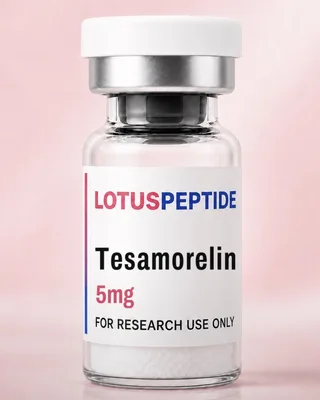
Tesamorelin
Tesamorelin is a synthetic 44-amino-acid analog of human growth hormone-releasing hormone (GHRH), with a trans-3-hexenoyl group added to its N-terminal tyrosine. It is the active ingredient of the FDA-approved prescription medicines Egrifta SV and Egrifta WR. The research material described here is not either of them.
- Single Vial$30
- 5-Pack (5 vials)$26 per vial$130
- 10-Pack (10 vials)$23.50 per vial Lowest per vial$235
Ships from the United States within 1 business day. Laboratory research use only.
At a glance
- Strengths
- 5 mg and 10 mg
- Also known as
- TH9507; TH-9507; (3E)-hex-3-enoyl-somatoliberin; tesamorelin acetate (salt form)
- CAS number
- 218949-48-5
- Molecular formula
- C221H366N72O67S
- Molecular weight
- 5136 g/mol (free base; FDA label: 5135.9 Da)
- Sequence
- (E)-hex-3-enoyl-YADAIFTNSYRKVLGQLSARKLLQDIMSRQQGESNQERGARARL-NH2 (44 residues)
- PubChem CID
- 16137828
What tesamorelin is
Tesamorelin is the complete 44-residue sequence of human GHRH, with one chemical change at the N-terminus. The native hormone is also called growth hormone-releasing factor (GRF) or somatoliberin. Theratechnologies developed tesamorelin under the code TH9507. Its nonclinical characterisation was published in 2007 1. The authors reported that adding a trans-3-hexenoyl group to Tyr1 made the peptide resistant to deactivation by dipeptidyl aminopeptidase-IV. Compared with the native peptide, it also degraded more slowly in rat, dog and human plasma in vitro 1. This stability is the main structural difference from native GHRH, whose amino acid sequence tesamorelin keeps unchanged. Tesamorelin should not be confused with sermorelin or CJC-1295. Those are separate synthetic GHRH analogs with their own structures and their own analytical reference data 2.
Chemical identity
The sequence is (E)-hex-3-enoyl-YADAIFTNSYRKVLGQLSARKLLQDIMSRQQGESNQERGARARL-NH2. It has one methionine, at position 27, and ends in leucinamide. PubChem lists tesamorelin as CID 16137828, with the formula C221H366N72O67S and a molecular weight of 5136 g/mol. The FDA label gives 5135.9 Da as the free base equivalent and describes the approved substance as an acetate salt. The CAS number for the free peptide is 218949-48-5. PubChem also records two deprecated CAS numbers, 804475-66-9 and 775305-79-8, which still appear in older documents. FDA's substance registry lists 901758-09-6 for tesamorelin acetate. Because it has more than 40 amino acids, FDA treats tesamorelin as a protein rather than a peptide, even though it is made by chemical synthesis.
Regulatory status
FDA approved tesamorelin as Egrifta, sponsored by Theratechnologies, on November 10, 2010, under application 022505. On March 23, 2020, under the Biologics Price Competition and Innovation Act, that approval was deemed a biologics license, now BLA 022505. FDA's published list of transitioned products names tesamorelin acetate (Egrifta and Egrifta SV). The current FDA labels, for Egrifta SV and Egrifta WR, set out the approved indication; they are available through Drugs@FDA. GHRH and its synthetic analogs are also prohibited in sport by the World Anti-Doping Agency 23. The tesamorelin sold here is not Egrifta. It is not covered by any FDA license, FDA has not assessed it, and it is intended for laboratory research only, not for administration to humans or animals.
Published research
The literature divides into the developer's programme and later analytical work.
- Nonclinical pharmacology (2007). Plasma stability in vitro and the nonclinical safety evaluation of TH9507 1.
- Development programme (reviewed 2009). A review of tesamorelin's development describes a multicentre, randomised, placebo-controlled phase 3 trial 4.
- Drug interaction study (2013). Two randomised, two-way crossover studies in healthy volunteers investigated the potential impact of tesamorelin on CYP3A activity by examining its effect on the pharmacokinetics of simvastatin and ritonavir 5.
- Anti-doping analysis (2016 and 2021). An immunoaffinity method with high-resolution mass spectrometry for four GHRH analogs in human plasma 3, and a study of in vitro metabolism with a liquid chromatography-tandem mass spectrometry method for detection in urine 2.
What is not known
The FDA label states that the long-term cardiovascular safety of the approved medicine has not been established. The approved medicines contain the inactive ingredients listed on their labels, which research material may not contain. Stability data for the medicines therefore cannot be assumed to apply to research powder. For research tesamorelin powder, the solid-state degradation products remain undescribed in the peer-reviewed literature. In vitro metabolites have been characterised for anti-doping purposes 2, but that work does not address storage of the solid.
Laboratory storage and handling
Store research tesamorelin as stated on the lot's certificate of analysis and product label. The Egrifta SV label allows controlled room temperature with protection from light, but that permission belongs to a formulated medicine and should not be read across to unformulated powder. Methionine 27 is the residue most likely to oxidise, so time with the vial open to air should be short. Moisture is the second concern: the vial should be at room temperature before it is opened, so that no condensation forms on the powder.
Quality testing
Identity on the certificate of analysis should rest on mass spectrometry: the free peptide's mass is about 5136 Da. That check also separates tesamorelin from unmodified GHRH(1-44) amide, which lacks the hexenoyl group and is about 96 Da lighter. A methionine-oxidised form appears 16 Da heavier. For purity, reversed-phase HPLC is the expected method, ideally reported with its chromatogram. Acetate content, together with water and peptide content, shows how much of a weighed amount is tesamorelin itself. A liquid chromatography-tandem mass spectrometry method for tesamorelin and its in vitro metabolites in urine has been published for anti-doping work 2, and an immunoaffinity method detects it in plasma 3.
Questions
Is tesamorelin the same as sermorelin or CJC-1295?
No. All three are synthetic analogs of GHRH, but they are different molecules with different structures and masses. Tesamorelin keeps the full 44-residue GHRH sequence and adds a trans-3-hexenoyl group to the first tyrosine. Mass spectrometry tells them apart.
Why does FDA regulate tesamorelin as a biologic?
FDA counts an amino acid polymer with more than 40 amino acids as a protein. Since a 2019 change in the law, chemically synthesised proteins fall under the definition of a biological product. Tesamorelin has 44 residues, so its approval was deemed a biologics license on March 23, 2020.
Is research-grade tesamorelin the same as Egrifta?
No. Egrifta SV and Egrifta WR are FDA-licensed medicines with defined formulations and controls. The material sold here is a laboratory reagent with the same intended peptide structure. FDA has not evaluated it, and it is not for human or animal use.
References
- Ferdinandi ES, Brazeau P, High K, et al. Non-clinical pharmacology and safety evaluation of TH9507, a human growth hormone-releasing factor analogue. Basic Clin Pharmacol Toxicol. 2007. pubmed.ncbi.nlm.nih.gov
- Memdouh S, Gavrilović I, Ng K, et al. Advances in the detection of growth hormone releasing hormone synthetic analogs. Drug Test Anal. 2021. pubmed.ncbi.nlm.nih.gov
- Knoop A, Thomas A, Fichant E, et al. Qualitative identification of growth hormone-releasing hormones in human plasma by means of immunoaffinity purification and LC-HRMS/MS. Anal Bioanal Chem. 2016. pubmed.ncbi.nlm.nih.gov
- Wang Y, Tomlinson B. Tesamorelin, a human growth hormone releasing factor analogue. Expert Opin Investig Drugs. 2009. pubmed.ncbi.nlm.nih.gov
- Teng S, Potvin D, Mamputu JC, et al. Impact of Tesamorelin, a Growth Hormone-Releasing Factor (GRF) Analogue, on the Pharmacokinetics of Simvastatin and Ritonavir in Healthy Volunteers. Clin Pharmacol Drug Dev. 2013. pubmed.ncbi.nlm.nih.gov
This page summarises published laboratory research and cites its sources. It is not medical advice and makes no claim that the compound treats, cures or prevents any condition. LotusPeptide sells it for laboratory research use only.
Shipping and returns
- Shipping
- Orders are processed and shipped within 1 business day.
- Returns
- Returns are not accepted.
- Damaged or lost items
- Replacements and refunds are offered on damaged or lost items.