In stock
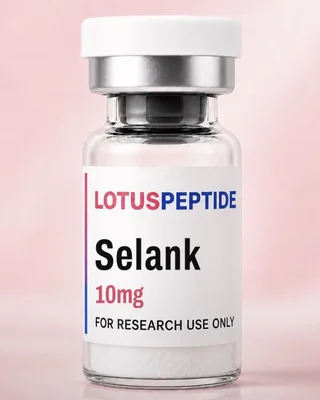
Selank 10mg
Selank is a synthetic seven-amino-acid peptide, Thr-Lys-Pro-Arg-Pro-Gly-Pro, whose first four residues reproduce the natural tetrapeptide tuftsin. It is registered as a medicine in Russia and has no FDA approval.
- Single Vial$30
- 5-Pack (5 vials)$27 per vial$135
- 10-Pack (10 vials)$20 per vial Lowest per vial$200
Ships from the United States within 1 business day. Laboratory research use only.
At a glance
- Strength
- 10 mg
- Also known as
- TP-7, Selanc, Thr-Lys-Pro-Arg-Pro-Gly-Pro
- CAS number
- 129954-34-3
- Molecular formula
- C33H57N11O9
- Molecular weight
- 751.9 g/mol
- Sequence
- Thr-Lys-Pro-Arg-Pro-Gly-Pro (TKPRPGP)
- PubChem CID
- 11765600
What Selank is
Selank is a tuftsin derivative: the tetrapeptide Thr-Lys-Pro-Arg is extended at its C-terminus by Pro-Gly-Pro, giving TKPRPGP 1. Russian papers describe it as a synthetic analog of tuftsin 2. Several of the gene-expression studies cited on this page come from the Institute of Molecular Genetics of the Russian Academy of Sciences in Moscow 34. Proline accounts for three of the seven residues. Every residue has the L configuration, the N-terminus is a free amine and the C-terminus a free acid, and there is no disulfide bond. Semax, a different peptide derived from ACTH, carries the same C-terminal Pro-Gly-Pro tail. Alternative names in PubChem include TP-7 and Selanc, and FDA's compounding records call the acetate salt selank acetate (TP-7).
Chemical identity and salt forms
PubChem CID 11765600 is the free base, C33H57N11O9, average mass 751.9 g/mol, CAS 129954-34-3. With a free N-terminal amine, a lysine and an arginine, Selank carries several positive charges at neutral pH, so suppliers normally isolate it as a salt. PubChem includes TP-7 (diacetate) among its synonyms. For laboratory calculations the counter-ion is not a detail. If a vial is labeled by total powder mass, part of that mass is counter-ion and residual water rather than peptide. Only a stated net peptide content lets a researcher work out how much Selank is actually present. Where a supplier gives no salt form, the material is best regarded as unspecified.
Regulatory status
FDA has not approved Selank, and openFDA's Drugs@FDA data return no record for it. On FDA's list of bulk drug substances that may present significant safety risks in compounding, selank acetate (TP-7) sits in the table of nominations withdrawn after being placed in category 2. The entry says FDA lacks important information on safety issues raised by selank acetate administered to humans. It also raises possible immunogenicity linked to aggregation and peptide-related impurities. Selank is registered as a medicine in Russia, which has no effect on its US status. The Selank supplied by this store is a laboratory research material and is not an approved medicine.
Published research
Laboratory and animal work makes up most of the Selank literature, and much of it appears in Russian journals. A 2001 enzyme study found that Selank inhibited the enkephalin-degrading enzymes of human serum in a concentration-dependent way, with an IC50 of 20 micromolar 1. The same study reported that its pentapeptide fragment also inhibited these enzymes, while the tri-, tetra- and hexapeptide fragments did not 1. In IMR-32 human neuroblastoma cells, Selank on its own left the mRNA levels of the GABAergic genes tested unchanged 3. Two expression-profiling studies examined rodent tissue after one administration. One measured 84 neurotransmission-related genes in rat frontal cortex 4. The other followed genes for chemokines, cytokines and their receptors in mouse spleen 6 and 24 hours later 2. Clinical studies in people are few and small, and most were published in Russian. In 52 healthy volunteers, a resting-state functional MRI study looked at brain connectivity after Selank, Semax or placebo 5.
What is not known
The breakdown of Selank is better described than its activity in people. Using peptides evenly labeled with tritium, one group found that blood plasma converts Selank mainly into TKPRP, TKP, RP and GP 6. In the mouse spleen work, the dipeptide Gly-Pro given alone changed most of the same genes in the same way as Selank 2. Together with the enzyme data on the pentapeptide 1, this means some fragments are themselves active in these assays. Studies that tracked only the intact heptapeptide are therefore harder to interpret; that is this page's reading, not the authors' claim. Long-term human data do not appear in the PubMed literature reviewed here. FDA says it lacks important human safety information on the acetate salt.
Quality testing
Identity and purity are the two results a Selank certificate has to establish. For identity, PubChem's monoisotopic mass of 751.434 Da for the free base puts the [M+H]+ ion at about m/z 752.44. Because the molecule has three basic sites, doubly charged ions are also worth checking in the spectrum. For purity, the HPLC method must resolve the intact heptapeptide from its own shorter sequences, since TKPRP and TKP are known breakdown products 6. Net peptide content, counter-ion and water content, appearance, lot number and analysis date complete a useful certificate. Batch purity is reported only on that batch's certificate.
Questions
How is Selank related to tuftsin?
Tuftsin is the tetrapeptide Thr-Lys-Pro-Arg. Selank keeps that sequence and adds Pro-Gly-Pro at the C-terminus, giving Thr-Lys-Pro-Arg-Pro-Gly-Pro. The two are distinct compounds with separate PubChem records and should not be substituted for each other.
Is Selank approved anywhere?
The FDA has not approved it, and it has no Drugs@FDA record. Selank is registered as a medicine in Russia, but a Russian registration has no bearing on how it is regulated in the United States.
Why might a Selank certificate list a counter-ion?
Selank is a basic peptide and is usually isolated as a salt. The counter-ion and residual water add to the powder mass, so the certificate should state the salt form and net peptide content.
References
- Kost NV, Sokolov OIu, Gabaeva MV, et al. [Semax and selank inhibit the enkephalin-degrading enzymes from human serum]]. Bioorg Khim. 2001. pubmed.ncbi.nlm.nih.gov
- Kolomin TA, Shadrina MI, Slominskiĭ PA, et al. [Changes in expression of the genes for chemokines, cytokines, and their receptors in response to selank and its fragments]. Genetika. 2011. pubmed.ncbi.nlm.nih.gov
- Filatova E, Kasian A, Kolomin T, et al. GABA, Selank, and Olanzapine Affect the Expression of Genes Involved in GABAergic Neurotransmission in IMR-32 Cells. Front Pharmacol. 2017. pubmed.ncbi.nlm.nih.gov
- Volkova A, Shadrina M, Kolomin T, et al. Selank Administration Affects the Expression of Some Genes Involved in GABAergic Neurotransmission. Front Pharmacol. 2016. pubmed.ncbi.nlm.nih.gov
- Panikratova YR, Lebedeva IS, Sokolov OY, et al. Functional Connectomic Approach to Studying Selank and Semax Effects. Dokl Biol Sci. 2020. pubmed.ncbi.nlm.nih.gov
- Zolotarev IuA, Dadaian AK, Dolotov OV, et al. [Evenly tritium-labeled peptides and their in vivo and in vitro biodegradation]. Bioorg Khim. 2006. pubmed.ncbi.nlm.nih.gov
This page summarises published laboratory research and cites its sources. It is not medical advice and makes no claim that the compound treats, cures or prevents any condition. LotusPeptide sells it for laboratory research use only.
Shipping and returns
- Shipping
- Orders are processed and shipped within 1 business day.
- Returns
- Returns are not accepted.
- Damaged or lost items
- Replacements and refunds are offered on damaged or lost items.