In stock
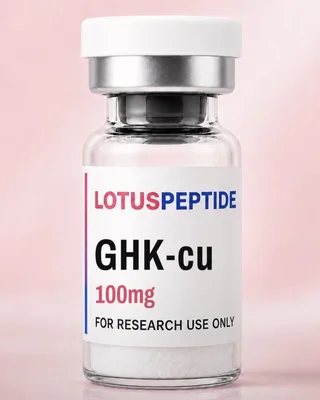
GHK-Cu
GHK-Cu is the copper(II) complex of GHK (glycyl-L-histidyl-L-lysine), a tripeptide found in plasma. The free peptide and its copper complex are separate substances with separate chemical records. It has no FDA approval as a drug, and the GHK-Cu listed here is a chemical for laboratory research.
- Single Vial$25
- 5-Pack (5 vials)$20 per vial$100
- 10-Pack (10 vials)$18.50 per vial Lowest per vial$185
Ships from the United States within 1 business day. Laboratory research use only.
Certificate of analysisGHK-Cu 100mg
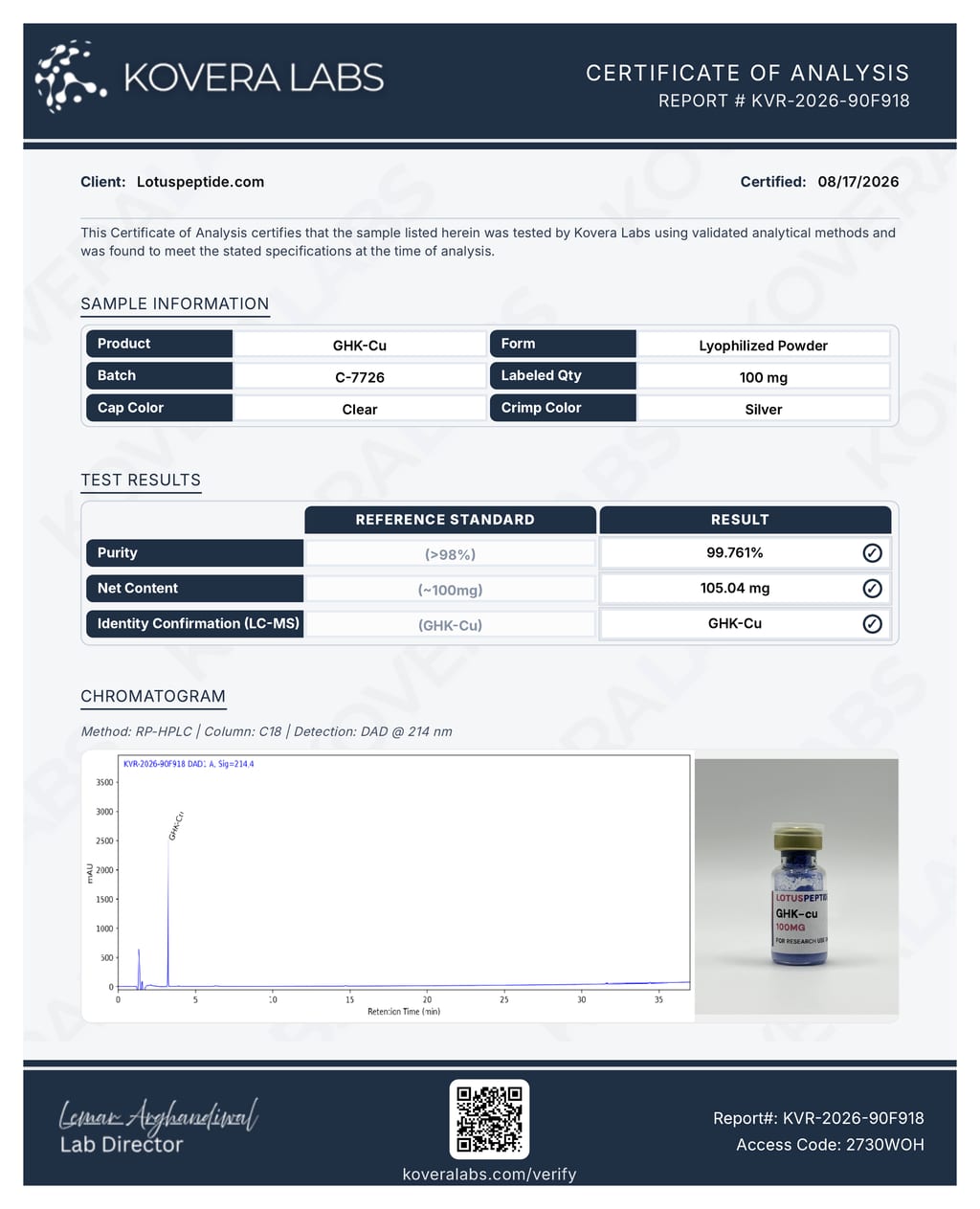
- Batch
- C-7726
- Purity
- 99.76% as reported by the lab
- Tested
- Lab
- Kovera
At a glance
- Strengths
- 50 mg, 100 mg and 50 mg dual pen
- Also known as
- Copper tripeptide-1; prezatide copper; GHK copper; glycyl-L-histidyl-L-lysine copper(II) complex
- CAS number
- 89030-95-5
- Molecular formula
- C14H23CuN6O4+
- Molecular weight
- 402.92 g/mol
- Sequence
- Gly-His-Lys (GHK) complexed with copper(II)
- PubChem CID
- 71587328
What GHK-Cu is
GHK-Cu is a small coordination complex in which the tripeptide Gly-His-Lys holds a copper(II) ion. A 1981 study described GHK as a tripeptide from plasma and measured how it binds copper(II). In equilibrium-dialysis experiments at pH 7.5, the peptide competed with albumin for copper(II) 1. Early papers abbreviated the peptide GHL 2. GHK also has a laboratory use of its own. Crystallographers have fused it to proteins as a copper-binding tag, which helped those proteins crystallize and allowed their structures to be solved by copper-based phasing 3. In the cosmetics sector the complex carries the INCI name copper tripeptide-1. PubChem lists that name, together with the name prezatide copper, on its record for the complex.
GHK and GHK-Cu are not interchangeable
The free peptide and the copper complex differ in composition, mass and behavior. Free GHK is C14H24N6O4 (340.38 g/mol, CAS 49557-75-7, PubChem CID 73587), while the complex adds a copper ion. At neutral pH, GHK forms a mononuclear 1:1 copper(II) complex in solution, with copper bound by nitrogen atoms that include one in the histidine imidazole ring 2. A potentiometric and spectroscopic study across pH 3.5 to 10.6 found several copper species and measured their stability constants 1. X-ray work showed that [Cu(II)(GHK)] is dimeric in the solid state but monomeric in solution, where the N-terminal amine, a deprotonated amide nitrogen and the imidazole hold the copper 4. The same work linked fast copper exchange between peptide molecules to a 2:1 species, [Cu(II)(GHK)2] 4. PubChem therefore holds separate records for 1:1 and 2:1 complexes. Ternary complexes with histidine 1 and with human serum albumin 5 have also been characterized.
Regulatory status
No GHK-Cu drug product has FDA approval, and Drugs@FDA returns nothing under the name prezatide copper. FDA lists GHK-Cu in its compounding bulk-substance categories, which are not approvals. FDA has also said it intends to consult its Pharmacy Compounding Advisory Committee about GHK-Cu before the end of February 2027. Its use as a cosmetic ingredient, under the INCI name copper tripeptide-1, is a separate matter and does not make any GHK-Cu product an approved drug. The GHK-Cu offered on this page is a research chemical for laboratory use, not a medicine.
Published research
The GHK-Cu literature falls into three groups: coordination chemistry, laboratory tools and formulation, and biological studies in cells and animals. The coordination chemistry is the best defined part, with solution structures 2, stability constants 1, crystal structures and redox measurements 4, and complexes with plasma proteins 5. The crystallography work uses the copper-binding property as a tool and makes no biological claim 3. Cell-culture and rodent studies of GHK-Cu have also been published by several groups. This page does not summarize them, because each finding belongs to its own model and none can be carried over to people. A PubMed search for GHK-Cu returned 182 records on October 3, 2026, for readers who want the primary papers.
What is not known
Human evidence for GHK-Cu is thin. In its compounding review, FDA noted limited data in humans. Results from cell cultures and animals cannot be assumed to apply to people. A second gap is speciation. The name GHK-Cu does not by itself say whether a sample is mainly the 1:1 complex, the 2:1 complex or a mix containing unbound copper, and the balance depends on ratio and pH 1 4. A third gap is analytical. Because copper exchanges quickly between GHK molecules 4, the conditions of a test can shift the species it detects.
Laboratory storage and handling
Store GHK-Cu as stated on its certificate of analysis and product label. A review of solid-state peptide stability lists deamidation, peptide bond cleavage, oxidation and aggregation, and names temperature and moisture content among the main factors 6. GHK-Cu adds a redox point. Electrochemical work found the complex inert under moderate redox conditions, but it can be reduced to copper(I) at strongly reducing potentials, with release of the copper ion 4. Mixing the material with reducing agents in an experiment can therefore change what is present.
Quality testing
A GHK-Cu certificate should cover both the peptide and the metal:
- Identity: mass spectrometry consistent with the GHK peptide and its copper complex.
- Peptide purity: reverse-phase HPLC. Spectroscopic titration places copper binding by GHK at an apparent pK of about 3.6 2, so a strongly acidic HPLC run mainly reports the peptide, not the intact complex.
- Copper content: a separate elemental measurement, such as ICP-MS or ICP-OES, with the copper-to-peptide ratio, since 1:1 and 2:1 complexes exist 4.
- Appearance: copper(II) species of GHK absorb visible light 1, so the certificate's appearance line should record the observed color.
The measured purity and copper figures for a lot appear only on that lot's certificate.
Questions
Is GHK the same as GHK-Cu?
No. GHK is the tripeptide Gly-His-Lys on its own (C14H24N6O4, 340.38 g/mol). GHK-Cu is that peptide bound to a copper(II) ion. The two have different CAS numbers and PubChem records, and in solution the copper complex exists as several pH-dependent species 1.
Why do sources give different molecular weights for GHK-Cu?
Copper and GHK form both 1:1 and 2:1 complexes 4, and databases draw the 1:1 complex in more than one charge state. PubChem lists 402.92 g/mol for the record named prezatide copper, 400.90 g/mol for another 1:1 record and 742.3 g/mol for the 2:1 complex. Salt and water content shift the figure further, so the certificate should name the form it tested.
What does FDA's compounding list say about GHK-Cu?
FDA lists GHK-Cu in its compounding bulk-substance categories, which are not approvals. No GHK-Cu product appears in Drugs@FDA, and FDA has said it plans to consult its Pharmacy Compounding Advisory Committee about GHK-Cu before the end of February 2027.
References
- Lau SJ, Sarkar B. The interaction of copper(II) and glycyl-L-histidyl-L-lysine, a growth-modulating tripeptide from plasma. Biochem J. 1981. pubmed.ncbi.nlm.nih.gov
- Freedman JH, Pickart L, Weinstein B, et al. Structure of the Glycyl-L-histidyl-L-lysine--copper(II) complex in solution. Biochemistry. 1982. pubmed.ncbi.nlm.nih.gov
- Mehr A, Henneberg F, Chari A, et al. The copper(II)-binding tripeptide GHK, a valuable crystallization and phasing tag for macromolecular crystallography. Acta Crystallogr D Struct Biol. 2020. pubmed.ncbi.nlm.nih.gov
- Hureau C, Eury H, Guillot R, et al. X-ray and solution structures of Cu(II) GHK and Cu(II) DAHK complexes: influence on their redox properties. Chemistry. 2011. pubmed.ncbi.nlm.nih.gov
- Bossak-Ahmad K, Bal W, Frączyk T, et al. Ternary Cu(2+) Complexes of Human Serum Albumin and Glycyl-l-histidyl-l-lysine. Inorg Chem. 2021. pubmed.ncbi.nlm.nih.gov
- Lai MC, Topp EM. Solid-state chemical stability of proteins and peptides. J Pharm Sci. 1999. pubmed.ncbi.nlm.nih.gov
This page summarises published laboratory research and cites its sources. It is not medical advice and makes no claim that the compound treats, cures or prevents any condition. LotusPeptide sells it for laboratory research use only.
Shipping and returns
- Shipping
- Orders are processed and shipped within 1 business day.
- Returns
- Returns are not accepted.
- Damaged or lost items
- Replacements and refunds are offered on damaged or lost items.