In stock
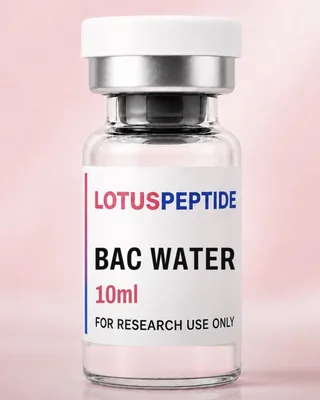
Bacteriostatic Water
Bacteriostatic water is sterile water containing 0.9% benzyl alcohol (9 mg per mL), added as a bacteriostatic preservative so that one vial can be entered more than once. The FDA-labelled product, bacteriostatic water (USP), is a prescription diluent whose label limits it to diluting or dissolving other drugs; Hospira's version has been FDA-approved since 1982. It is a solution of two substances, water and benzyl alcohol, not a single compound.
- Single Vial$8
- 5-Pack (5 vials)$8 per vial$40
- 10-Pack (10 vials)$7 per vial Lowest per vial$70
Ships from the United States within 1 business day, to the US and the UK and Europe. Laboratory research use only.
Lab results
Certificates for this compound are published on the lab results page as batches are tested.
At a glance
- Strengths
- 3 mL and 10 mL
- Also known as
- Bacteriostatic Water, Water,bacteriostatic
What bacteriostatic water is
Hospira's label describes bacteriostatic water (USP) as a sterile, nonpyrogenic preparation of water with 0.9% (9 mg/mL) or 1.1% (11 mg/mL) benzyl alcohol added as a bacteriostatic preservative 1. It is supplied in a container from which repeated withdrawals may be made to dilute or dissolve other drugs 1. Its label states that it is to be used only as a diluent or solvent 1. The preservative is there for the period after the vial is first opened: FDA describes antimicrobial effectiveness testing as determining whether a product prevents microbial growth if the container is contaminated during use 5.
FDA-approved labels for some freeze-dried peptide and protein products name bacteriostatic water as the diluent supplied in the package 1314. Egrifta WR, a lyophilised form of tesamorelin, comes with a 30 mL bottle of bacteriostatic water (USP), and each vial of Novarel, a urine-derived chorionic gonadotropin, comes with a 10 mL vial containing 0.9% benzyl alcohol 1314. On this site it is listed as a laboratory diluent alongside freeze-dried research peptides such as BPC-157 and GHK-Cu.
Composition
The label lists two components, water and benzyl alcohol, and no other ingredient 1. Hospira supplies the 0.9% (9 mg/mL) solution in 30 mL plastic vials and a 1.1% (11 mg/mL) solution in 20 mL glass vials 1. The label gives a pH of 5.7, with a range of 4.5 to 7.0 1. The plastic vial is a polyolefin, a copolymer of ethylene and propylene, and the label states that it needs no vapour barrier to keep its labelled volume 1.
- Water: PubChem CID 962, formula H2O, molecular weight 18.015 g/mol 3.
- Benzyl alcohol: PubChem CID 244, also called phenylmethanol (CAS 100-51-6), formula C7H8O, molecular weight 108.14 g/mol 4.
The ChEBI description in PubChem defines benzyl alcohol as an aromatic alcohol consisting of benzene bearing a single hydroxymethyl substituent, with roles that include solvent and antioxidant 4.
Why it contains benzyl alcohol
FDA's 2018 guidance on package types defines a container meant to be entered more than once as one holding a sterile medication, a term that covers diluents as well as active drugs, that has met antimicrobial effectiveness testing requirements (or is excluded from such testing by FDA regulation) 5. The guidance notes that some formulations pass that testing without an added preservative, while others rely on one 5. It adds that such containers are generally expected to hold 30 mL or less 5. A 1982 CDC report described benzyl alcohol as an aromatic alcohol usually used at 0.9% as a bacteriostatic preservative in vials of solutions or drugs for parenteral therapy 8. A 2007 review of licensed parenteral products found that phenol and benzyl alcohol were the two most common antimicrobial preservatives in peptide and protein products 7. The same review found benzyl alcohol, or methylparaben with propylparaben, generally used in small-molecule formulations 7.
Bacteriostatic water, sterile water and sodium chloride 0.9%
These are three different solutions, and their FDA labels describe them differently.
- Sterile water (USP) is the same grade of water with no preservative: its label states that it contains no bacteriostat, antimicrobial agent or added buffer and is supplied only in containers meant for one use, with any unused portion discarded 9.
- Sodium chloride 0.9% (USP) contains 900 mg of sodium chloride per 100 mL, with a calculated osmolarity of 308 mOsmol/L that its label calls isotonic 10. That label also states the solution contains no bacteriostat, antimicrobial agent or added buffer 10.
- Bacteriostatic sodium chloride 0.9% (USP) combines the two ideas: 9 mg of sodium chloride and 9 mg of benzyl alcohol per mL, in a container for repeated withdrawals, with a pH of 5.0 (4.5 to 7.0) 6.
Both water labels state that the water must be made approximately isotonic before use, and both warn that intravenous administration of the water without a solute may result in hemolysis 19. Bacteriostatic water therefore differs from saline in containing no sodium chloride, and from sterile water in containing a preservative 1910.
Regulatory status
Drugs@FDA lists Hospira's bacteriostatic water in plastic containers under NDA 018802, a prescription product first approved on October 27, 1982 2. Its label is marked Rx only 1. The bacteriostatic water on this page is supplied as a laboratory research material; the FDA labels quoted here describe the approved USP product and are cited to define the material.
Label warnings
The label opens with the warning "not for use in neonates" 1. It states that benzyl alcohol has been associated with toxicity in neonates, and that where water is needed to prepare or dilute medications for neonates, only preservative-free sterile water should be used 1. Its contraindications add that preparations with benzyl alcohol should not be used for fluid replacement or in epidural or spinal anaesthesia procedures 1. The label also notes that some drugs may be incompatible in a vehicle containing benzyl alcohol 1.
Reports of neonatal toxicity date to 1982, when CDC reported 16 deaths of pre-term infants at two medical centres whose intravascular catheters had been flushed periodically each day with bacteriostatic saline containing 9 mg/mL benzyl alcohol 8. The infants developed metabolic acidosis that progressed to respiratory distress and gasping respirations 8. The report explained that benzyl alcohol is normally oxidised to benzoic acid, conjugated with glycine in the liver and excreted as hippuric acid, a pathway that may not be well developed in premature infants 8. FDA then recommended that flush solutions containing benzyl alcohol not be used for newborns 8. A 1986 review of 26 months of records at one neonatal intensive care unit found that, among infants under 1,000 g, mortality fell from 80.7% to 45.7% after solutions containing benzyl alcohol were stopped 11.
Storage as stated on the label
The label states that the vials are stored at 20 to 25 °C (68 to 77 °F), USP controlled room temperature 1. It also states that the solution is not to be used unless it is clear and the seal is intact 1. For a container of this type that has been opened or entered, FDA's guidance gives a beyond-use date of 28 days unless the manufacturer's label specifies otherwise 5. For that reason such containers do not normally carry a discard statement, and Hospira's label gives no other period 15.
What is not known
Benzyl alcohol can affect the material dissolved in it. In a 2005 study of a freeze-dried recombinant protein, interleukin-1 receptor antagonist, dissolving the dried solid in 0.9% benzyl alcohol caused more aggregation than dissolving it in water 12. The extent depended on how much native structure the protein kept through freeze-drying, and benzyl alcohol did not accelerate aggregation during later storage at room temperature 12. That study concerned one protein, so it does not establish how any other peptide or protein behaves in benzyl alcohol 12. FDA's 28-day period is an assumed default for entered containers, and the guidance asks for a discard statement supported by data when a product's period differs 5. Published certificates of analysis are listed with our lab results.
Questions
What is in bacteriostatic water?
Water and benzyl alcohol. The FDA-labelled USP product is sterile, nonpyrogenic water with 0.9% (9 mg/mL) benzyl alcohol added as a bacteriostatic preservative, and Hospira also lists a 1.1% version; the label gives a pH of 5.7 (4.5 to 7.0) and no other ingredient 1.
Is bacteriostatic water the same as sterile water?
No. Sterile water (USP) contains no bacteriostat, antimicrobial agent or added buffer and comes in containers meant for one use, while bacteriostatic water contains 0.9% benzyl alcohol so that the vial can be entered more than once 19.
Is bacteriostatic water the same as saline?
No. Saline is 0.9% sodium chloride, which its label calls isotonic at a calculated 308 mOsmol/L, while bacteriostatic water contains no sodium chloride and its label states it must be made approximately isotonic before use 110. A separate product, bacteriostatic sodium chloride 0.9%, contains both sodium chloride and 0.9% benzyl alcohol 6.
What does FDA guidance say about a container that has been opened?
FDA's 2018 guidance states that the beyond-use date for an opened or entered container of an approved product meant to be entered more than once is 28 days, unless the manufacturer's label specifies otherwise 5. Hospira's label gives no other period and states storage at 20 to 25 °C (68 to 77 °F) 1. Hospira's label gives no other period and states storage at 20 to 25 °C (68 to 77 °F) 1.
Why is bacteriostatic water labelled not for use in neonates?
Its preservative, benzyl alcohol, has been associated with toxicity in neonates 1. In 1982 CDC reported 16 deaths of pre-term infants given catheter flushes of bacteriostatic saline containing benzyl alcohol, and noted that the pathway that clears benzyl alcohol may not be well developed in premature infants 8.
Does LotusPeptide ship Bacteriostatic Water to the UK and Europe?
Yes. Bacteriostatic Water ships from the United States to the United Kingdom and 13 EU countries by UPS Worldwide Express: $55 flat for a standard package, typically 2 to 5 days in transit. Import VAT, duties and fees are paid by the recipient on delivery, and orders to the UK and Europe are paid in cryptocurrency at checkout. Details are on the UK and Europe page.
Is there a certificate of analysis for Bacteriostatic Water?
Not yet. No batch certificate for Bacteriostatic Water is published at the moment. Certificates are added to the lab results page as each batch is tested.
References
- DailyMed. BACTERIOSTATIC WATER injection, solution (Hospira, Inc.), Bacteriostatic Water for Injection, USP. National Library of Medicine. Label revised 08/2019. dailymed.nlm.nih.gov
- U.S. Food and Drug Administration. Drugs@FDA: FDA-Approved Drugs. NDA 018802, Bacteriostatic Water for Injection in Plastic Container (Hospira). www.accessdata.fda.gov
- PubChem. Water, CID 962. National Library of Medicine. pubchem.ncbi.nlm.nih.gov
- PubChem. Benzyl Alcohol, CID 244. National Library of Medicine. pubchem.ncbi.nlm.nih.gov
- U.S. Food and Drug Administration. Selection of the Appropriate Package Type Terms and Recommendations for Labeling Injectable Medical Products Packaged in Multiple-Dose, Single-Dose, and Single-Patient-Use Containers for Human Use. Guidance for Industry. October 2018. www.fda.gov
- DailyMed. BACTERIOSTATIC SODIUM CHLORIDE- sodium chloride injection, solution (Hospira, Inc.), Bacteriostatic 0.9% Sodium Chloride Injection, USP. National Library of Medicine. Label revised 02/2019. dailymed.nlm.nih.gov
- Meyer BK, Ni A, Hu B, et al. Antimicrobial preservative use in parenteral products: past and present. J Pharm Sci. 2007. pubmed.ncbi.nlm.nih.gov
- Centers for Disease Control (CDC). Neonatal deaths associated with use of benzyl alcohol--United States. MMWR Morb Mortal Wkly Rep. 1982. pubmed.ncbi.nlm.nih.gov
- DailyMed. STERILE WATER- water injection (Hospira, Inc.), Sterile Water for Injection, USP. National Library of Medicine. Label revised 3/2025. dailymed.nlm.nih.gov
- DailyMed. SODIUM CHLORIDE injection, solution (Hospira, Inc.), Sodium Chloride Injection, USP, ADD-Vantage Diluent Flexible Plastic Container. National Library of Medicine. dailymed.nlm.nih.gov
- Hiller JL, Benda GI, Rahatzad M, et al. Benzyl alcohol toxicity: impact on mortality and intraventricular hemorrhage among very low birth weight infants. Pediatrics. 1986. pubmed.ncbi.nlm.nih.gov
- Roy S, Jung R, Kerwin BA, et al. Effects of benzyl alcohol on aggregation of recombinant human interleukin-1-receptor antagonist in reconstituted lyophilized formulations. J Pharm Sci. 2005. pubmed.ncbi.nlm.nih.gov
- DailyMed. EGRIFTA WR- tesamorelin kit (Theratechnologies Inc.). National Library of Medicine. dailymed.nlm.nih.gov
- DailyMed. NOVAREL- gonadotrophin, chorionic kit (Ferring Pharmaceuticals Inc.). National Library of Medicine. dailymed.nlm.nih.gov
This page summarises published laboratory research and cites its sources. It is not medical advice and makes no claim that the compound treats, cures or prevents any condition. LotusPeptide sells it for laboratory research use only.
Shipping and returns
- Shipping
- Orders are processed and shipped within 1 business day.
- UK and Europe
- UPS Worldwide Express, $55 flat, typically 2 to 5 days in transit. Countries, VAT and duties
- Returns
- Returns are not accepted.
- Damaged or lost items
- Replacements and refunds are offered on damaged or lost items.