In stock
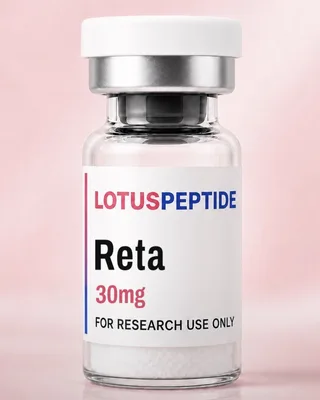
Retatrutide
Retatrutide (LY3437943) is a synthetic 39-amino-acid peptide carrying a C20 fatty diacid side chain, built to act at three hormone receptors: GIP, GLP-1 and glucagon. Eli Lilly is developing it, and it remains investigational. FDA has not approved any product that contains it.
- Single Vial$50
- 5-Pack (5 vials)$38 per vial$190
- 10-Pack (10 vials)$37.50 per vial Lowest per vial$375
Ships from the United States within 1 business day. Laboratory research use only.
Certificate of analysisRetatrutide 30mg
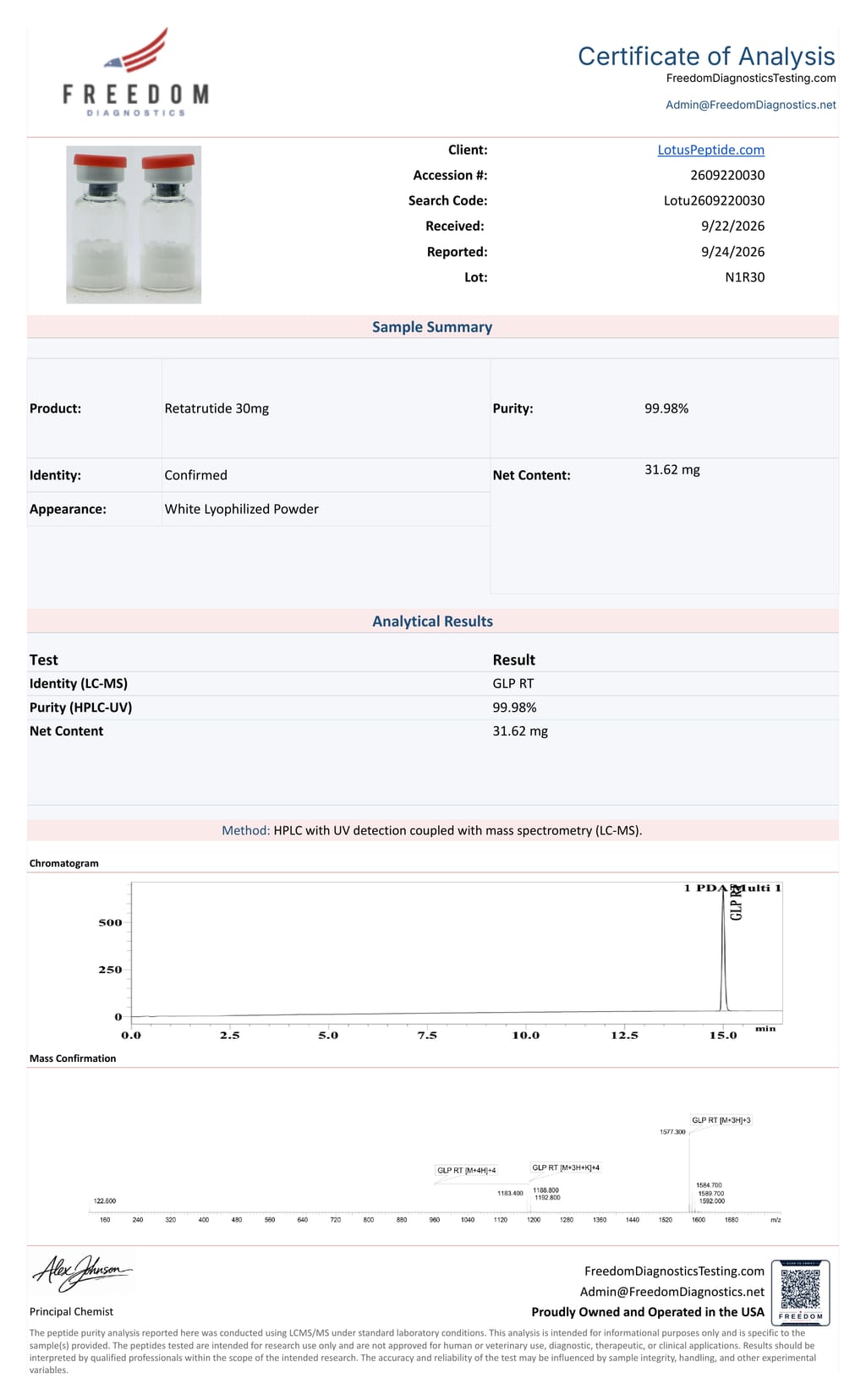
- Batch
- N1R30
- Purity
- 99.98% as reported by the lab
- Tested
- Lab
- Freedom Diagnostics
At a glance
- Strengths
- 5 mg, 10 mg, 15 mg, 20 mg, 30 mg, 15 mg dual pen and 30 mg dual pen
- Also known as
- LY3437943; LY-3437943; Triple G
- CAS number
- 2381089-83-2
- Molecular formula
- C221H342N46O68
- Molecular weight
- 4731 g/mol
- Sequence
- Y-Aib-QGTFTSDYSI-(alpha-Me-Leu)-LDK-K(gamma-Glu-AEEA-C20 diacid)-AQ-Aib-AFIEYLLEGGPSSGAPPPS-NH2 (39 residues; Lys17 acylated)
- PubChem CID
- 171390338
What retatrutide is
Retatrutide is a single peptide that targets three receptors: the glucagon receptor (GCGR), the GIP receptor (GIPR) and the glucagon-like peptide-1 receptor (GLP-1R) 12. The literature therefore calls it a triple agonist. Its development code is LY3437943, and structural and analytical papers give both names 23. Eli Lilly is its developer and the sponsor of its phase 3 programme. Retatrutide is related to tirzepatide, which acts at GIPR and GLP-1R only. The two are different molecules, with different sequences, side chains and masses, so one cannot stand in for the other as a research material. In this catalogue the name refers to the single defined structure described in the next section, and every lot should be checked against that structure rather than against the name on the label.
Structure and chemical identity
The backbone has 39 amino acids and ends in a C-terminal amide. Three residues are not among the standard twenty: 2-aminoisobutyric acid (Aib) at positions 2 and 20, and alpha-methyl-leucine at position 13. The lysine at position 17 carries a fatty diacid attached through a linker 2; by its CAS index name, the side chain is built from a gamma-glutamic acid, one amino-ethoxy-ethoxy-acetic acid spacer and a 20-carbon diacid. PubChem holds the parent structure as CID 171390338, with the formula C221H342N46O68 and a molecular weight of 4731 g/mol. That record is titled "Triple G", and the substance records deposited under the name retatrutide map to it. The CAS number is 2381089-83-2, recorded both in PubChem and in FDA's substance registry. Synthesis has relied mainly on solid-phase peptide synthesis, and a liquid-phase route using a hydrophobic tag has also been reported 1.
Regulatory status
Retatrutide is investigational: FDA has not approved it for any use, and Drugs@FDA held no application record for it when checked on October 2, 2026. Eli Lilly is the sponsor. On ClinicalTrials.gov, Lilly's phase 3 programme is registered under the name TRIUMPH. TRIUMPH-1 to TRIUMPH-4 were recorded as completed and TRIUMPH-5 to TRIUMPH-9 as active, not recruiting, at that check. The retatrutide sold here is a laboratory research material. FDA has not approved it, and it must not be used in people or animals.
Published research and registered studies
Published work on retatrutide falls into two groups: human trials run by the sponsor, and chemistry and analytical studies from other laboratories.
- Registered human studies. There are more than 30 registered studies, almost all sponsored by Lilly, covering phase 1, phase 2 and phase 3 (ClinicalTrials.gov, checked 3 October 2026).
- Trial reports. Phase 2 and phase 3 reports are indexed in PubMed. This page describes the compound, not those results.
- Synthesis (2026). A hydrophobic tag-assisted liquid-phase method was presented as an alternative to solid-phase synthesis 1.
- Structural biology (2024). Cryo-electron microscopy structures of GLP-1R, GIPR and GCGR, each bound to retatrutide. The authors described conserved peptide and receptor contacts alongside receptor-specific conformations, particularly in extracellular loop 1 2.
- Analytical methods (2026). A liquid chromatography and high-resolution mass spectrometry method for retatrutide in plasma and urine, validated to World Anti-Doping Agency criteria 3, and a multiplexed method that identifies nine incretin-class peptides, retatrutide and tirzepatide among them 4.
What is not known
Most of the phase 3 programme was still active at the October 2026 registry check (ClinicalTrials.gov), so its results are still being reported. Trial reports do not establish the identity, purity or stability of research material from other manufacturers; each lot has to show those itself. A PubMed search found no stability study of lyophilised retatrutide. How the peptide degrades in the solid state, and which impurities dominate after storage, has not been described.
Laboratory storage and handling
Store each vial as stated on its certificate of analysis and product label, because no published stability data exist for the powder. The sequence has no methionine, cysteine or tryptophan, the residues most prone to oxidation, which leaves moisture and temperature as the main factors a laboratory controls. A cold vial should warm to room temperature while still closed, because a cold, open vial draws in moist air. Weighing out portions once, rather than opening the same vial many times, limits that exposure.
Quality testing
A certificate of analysis for retatrutide should confirm identity by mass spectrometry. The measured mass should match the expected value of about 4731 Da, which also separates retatrutide from tirzepatide at about 4813 Da. In the published plasma method, detection was based on the triply protonated ion, [M+3H]3+ 3. A multiplexed method combines accurate full-scan mass with fragment spectra for structural confirmation, and it identifies retatrutide, tirzepatide and seven related peptides in a single 20-minute run 4. Purity should be measured by reversed-phase HPLC, with the chromatogram and the integration method shown. Useful additions are peptide content as a percentage of the powder, the counter-ion and water content. For an acylated synthetic peptide, the most informative related impurities are truncated sequences and molecules missing the fatty diacid side chain. A good certificate states whether these were looked for. Purity figures belong to each batch and are reported on that batch's certificate, not on this page.
Questions
Is retatrutide approved by FDA?
No. Retatrutide is investigational. Drugs@FDA had no application record for it when checked on October 2, 2026, and its phase 3 trials are sponsored by Eli Lilly. The material sold here is a laboratory research reagent, not a medicine.
What is "Triple G"?
It is an informal name. PubChem titles its retatrutide structure record (CID 171390338) "Triple G". It does not describe a different compound.
What does LY3437943 refer to?
LY3437943 is Eli Lilly's development code for retatrutide. Registry entries and some papers use the code, sometimes alongside the name, and both refer to the same structure.
References
- Mao CY, Pang ZJ, Qiao GY, et al. A Hydrophobic Tag-Assisted Liquid-Phase Strategy for the Synthesis of Retatrutide. Org Lett. 2026. pubmed.ncbi.nlm.nih.gov
- Li W, Zhou Q, Cong Z, et al. Structural insights into the triple agonism at GLP-1R, GIPR and GCGR manifested by retatrutide. Cell Discov. 2024. pubmed.ncbi.nlm.nih.gov
- Carneiro GRA, da Costa Nunes IK, Dos Santos Cardoso GR, et al. Detection and Excretion Profile of Retatrutide in Human Plasma and Urine by LC-HRMS: Implications for Antidoping Analysis. Rapid Commun Mass Spectrom. 2026. pubmed.ncbi.nlm.nih.gov
- Tong LH, Leung KK, Hung CT. Development and validation of a multiplexed LC-HRMS method for nine GLP-1 receptor agonists and its pharmaceutical application. J Chromatogr A. 2026. pubmed.ncbi.nlm.nih.gov
This page summarises published laboratory research and cites its sources. It is not medical advice and makes no claim that the compound treats, cures or prevents any condition. LotusPeptide sells it for laboratory research use only.
Shipping and returns
- Shipping
- Orders are processed and shipped within 1 business day.
- Returns
- Returns are not accepted.
- Damaged or lost items
- Replacements and refunds are offered on damaged or lost items.